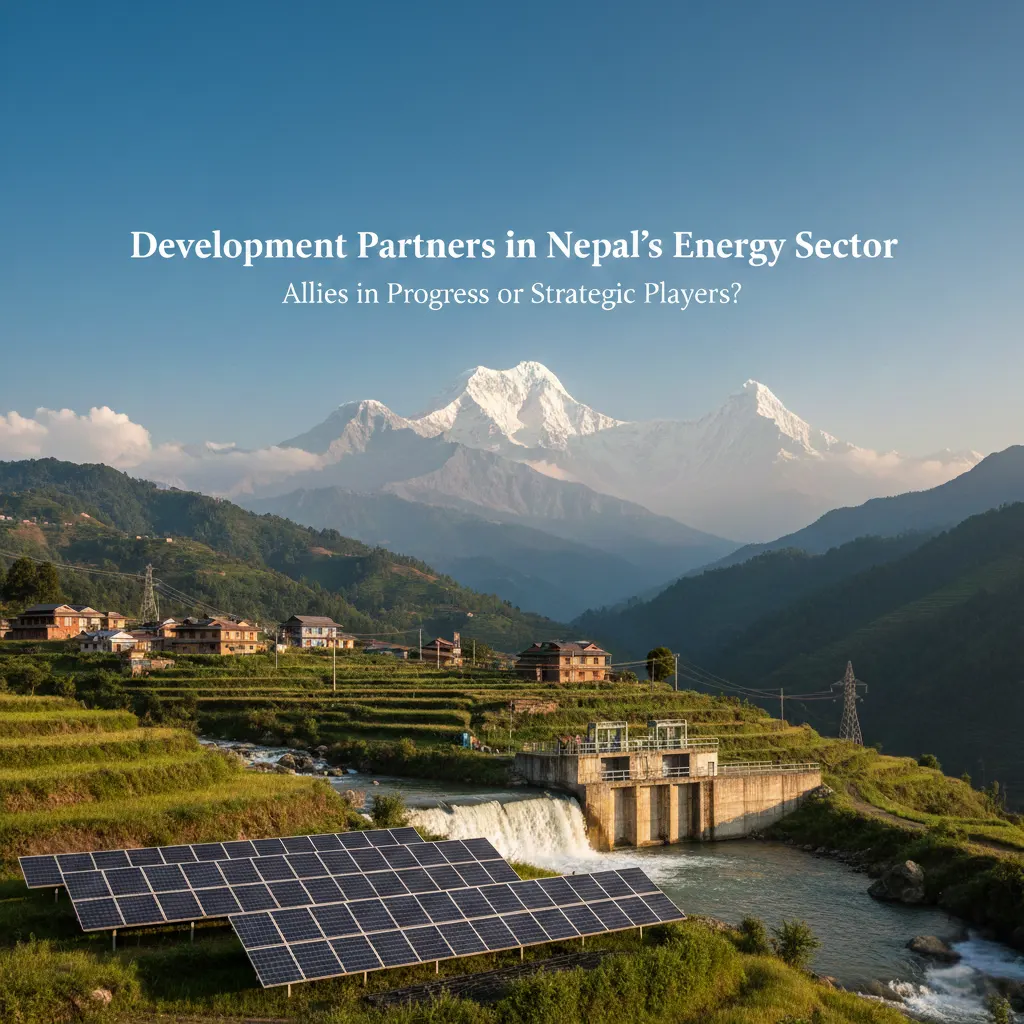
Nepal relies heavily on international development partners, comprising both donor governments and multilateral agencies, to support its ambitious goals for rural energy and climate resilience. The country’s top five aid partners today remain the World Bank, the Asian Development Bank (ADB), the United Kingdom, the United States, and the European Union. In the fiscal year 2019/20, Nepal received approximately $2.0 billion in official development assistance (ODA). Most of this aid is now structured as concessional loans, accounting for roughly 70 per cent of total ODA, while the remainder is provided as technical assistance and direct grants.
These development partners serve a vital role in filling Nepal’s domestic funding gaps while facilitating the transfer of technology and expertise in sectors such as solar power, hydropower, and biogas.
For example, multilateral lenders and bilateral donors have financed over 450 small hydropower plants to date, bringing electricity to roughly 100,000 off-grid households and supporting national programmes to expand clean cooking and solar energy adoption.
Major Donors and Strategic Mechanisms
Funding for Nepal’s energy transition originates from bilateral budgets, such as USAID, GIZ/BMZ Germany, KfW Germany, and SNV Netherlands, as well as multilateral sources including the World Bank’s International Development Association (IDA), the ADB, and the Green Climate Fund (GCF). Recently, the United Kingdom’s Foreign, Commonwealth and Development Office (FCDO) announced a new £400 million portfolio for Nepal extending to 2030, which is specifically aimed at climate resilience and economic transformation. Similarly, Germany’s development bank, KfW, provides a strategic mix of loans and grants for critical energy and water infrastructure.
In 2024, the collaboration involved an EU, KfW, and ADB joint project to upgrade a 220 kV transmission line to evacuate hydropower from remote districts to urban centres. In recent years, the share of budget support, known as on-treasury aid, rose sharply from 15 per cent to nearly 37 per cent of total ODA. This reflects a concerted effort by the Government of Nepal to bring donor funds under national oversight. While the ADB and World Bank remain the largest multilateral contributors, the most significant bilateral donors continue to be the USA, UK, India, China, and Japan.
Why Donors Support Nepal
Donor agencies channel aid to Nepal to support economic and social objectives that align with their international agendas, including poverty alleviation, climate action, and regional stability. Nepal remains a low income, mountainous country where foreign assistance contributes significantly to the national development budget, particularly for infrastructure and human capital. National priorities such as Sustainable Development Goals implementation and LDC graduation continue to rely heavily on external support, with both government authorities and donors placing strong emphasis on rural development, energy access, and disaster resilience.
In practice, this means donors often target underserved sectors, including remote village electrification and women’s livelihoods. As everyone is familiar with, clean energy is a top priority because a small but significant portion of Nepali households (4%) still lack reliable electricity. Development partners fund renewable power and clean cooking projects to help Nepal meet its global commitments under the Paris Agreement. Nepal’s 2015 constitution and the Sustainable Development Goal (SDG) framework assume continued international support to combat poverty and build a “Prosperous Nepal.”
How Development Partners Operate in Nepal
Funding flows. Donors use a mix of project grants, soft loans, and technical assistance. Some aid is “tied” to goods/services from the donor country, though less so than in past decades. Increasingly, donors provide budgetary support or use national financial systems (on-budget aid) to improve alignment. However, much aid remains “off-budget” via NGOs or UN agencies.
Major donors often work through government institutions like the Alternative Energy Promotion Centre (AEPC) under the Ministry of Energy. The AEPC serves as the primary implementing partner for energy programmes, often supervised by co-financiers and donor committees. These partnerships extend to local municipalities, private companies, and community user groups. In renewable energy projects, the public sector provides policy guidance and subsidies, while the private sector is responsible for the physical installation of equipment — the same AEPC subsidy and VGF mechanisms covered from the financing side in how solar financing works in Nepal.
Capacity building is perhaps the most enduring role of development partners. Germany’s GIZ, for example, has helped establish five solar energy training centres nationwide. These centres teach solar planning and maintenance, with nearly 600 Nepali technicians trained to date. SNV Netherlands has similarly worked with rural municipalities in the Karnali and Sudurpaschim provinces to improve local energy planning. This shift ensures that local engineers and energy planners are equipped to manage systems long after the international experts have departed.
Key Donor Programmes in Renewable Energy
- The Biogas Support Programme (BSP), launched in 1992 by SNV with support from the Netherlands, is a global model for scaling rural technology. By 2009, it had installed over 200,000 household biogas plants. These plants use cattle manure to generate cooking gas, saving thousands of tonnes of firewood annually. Today, the programme is co-managed by AEPC and local NGOs, demonstrating how long-term donor funding can create self-sustaining local industries.
- The Nepal Renewable Energy Programme (NREP) is a UK Aid initiative that has shifted the focus toward private sector engagement. Between 2019 and 2024, NREP worked to develop a National Small-Scale Renewable Energy Framework. By introducing mechanisms like Viability Gap Funding (VGF), NREP helps de-risk private investment in mini grids and solar pumps, moving away from a model of pure charity toward one of market development.
- The Renewable Energy for Rural Livelihoods (RERL) project, a joint initiative of the UNDP and the Government of Nepal, has been active since 2011. This programme has been instrumental in rolling out hundreds of mini hydro and solar systems in remote hill districts. More recently, the project has focused on the financial closure and community mobilisation required for 4.8 MW of new mini hydro and solar projects, with a strong emphasis on gender equality and social inclusion — the same site assessment and feasibility discipline covered in solar PV feasibility studies generally.
- Energising Development (EnDev) is a multi-donor programme implemented by SNV that targets off-grid communities in the most remote regions. By installing pico hydro systems and high-efficiency cookstoves, EnDev works directly with rural municipalities to ensure local governments can co-manage and maintain these assets.
- GIZ Solar Energy Training (BMZ), in partnership with AEPC and SEMAN, developed a national solar training curriculum to address skill gaps among Nepali technicians. Through BMZ support, solar installation, maintenance, and design courses were launched at five centres across Nepal, co-funded by municipalities and energy companies, with up to 50% cost subsidies from GIZ. Nearly 600 Nepalis have been trained so far, strengthening local capacity for off-grid solar systems and supporting long-term, self-sustaining training providers.
The Strategic Shift: LDC Graduation and Federalism
A critical new factor in the relationship between Nepal and its development partners is the country’s scheduled graduation from Least Developed Country (LDC) status in November 2026. This transition will likely result in a reduction of pure grants and a further shift toward concessional and commercial loans. Development partners are already preparing for this by focusing on “Green, Resilient, and Inclusive Development” (GRID), a framework that seeks to align international aid with long term sustainable investment.
Furthermore, Nepal’s transition to a federal structure has changed the operational landscape. Local governments now have more authority over small-scale energy projects. Consequently, partners like GIZ and the World Bank are increasingly focusing on “sub-national” capacity building, ensuring that newly formed municipalities have the technical expertise to manage their own energy resources.
The Benefits of Development Assistance
When well designed, donor-funded programmes bring profound gains. Key benefits include:
- Expanded Energy Access: Donor projects have electrified thousands of villages (via RERL, SNV/EnDev, ADB, etc.). Over 100,000 households gained power from micro hydro plants alone. Transmission expansions supported by “Team Europe” will soon allow an additional 650 MW of rural hydropower to reach the national grid.
- Environmental and Health Gains: Biogas and solar programmes significantly reduce reliance on firewood, which decreases indoor air pollution, a major health hazard for women and children in rural areas.
- Economic Development: Infrastructure projects stimulate local economies and create jobs. UK Aid estimates its investments will leverage over $1 billion in private capital and create 13,500 jobs by 2030.
- Poverty Reduction: By targeting the poorest regions, aid improves livelihoods through “productive uses” of energy, such as agro processing and irrigation, which boost farmer incomes.
Criticisms and Challenges of Foreign Aid
Despite these successes, the presence of development partners faces valid criticisms. One primary concern is aid dependency, where excessive reliance on foreign funds can stifle local initiative and allow donors to dictate national priorities. Some experts argue that aid sometimes comes “with strings attached,” requiring Nepal to adopt specific legal frameworks that may not perfectly suit the local context.
Coordination remains another challenge. With numerous donors and NGOs operating simultaneously, there is a risk of duplicating efforts or creating fragmented projects that lack a unified strategy. Furthermore, governance and corruption concerns in Nepal can limit the effectiveness of aid, leading some donors to bypass government systems entirely, which can weaken state institutions in the long run.
Short-term funding cycles also make aid unpredictable and poorly aligned with long infrastructure timelines. For example, the suspension and funding cuts to USAID programs in Nepal in early 2025 abruptly halted ongoing projects in health education and governance. Such sudden shifts in donor priorities disrupt planning and threaten continuity of development outcomes.
Finally, there are knowledge gaps where foreign experts may lack an understanding of rural social norms. Installing a solar pump without a plan for local maintenance or spare parts supply chains often leads to abandoned equipment. To mitigate this, modern programmes are moving toward participatory planning and local hiring.
In Conclusion
Development partners are indispensable allies in Nepal’s quest for energy security and climate resilience. However, as industry analysts suggest, the long-term success of the sector depends on moving from aid dependency to local ownership.
Ideally, development partners should act as catalysts, providing the initial technology and capacity building, while the Government of Nepal and the local private sector ensure that these programmes are absorbed into the national economy. As Nepal approaches its 2026 LDC graduation, the focus must remain on building a coherent energy ecosystem where international support and local equity work hand in hand to power sustainable development.
Frequently asked
Who are Nepal’s top development partners in the energy sector? The World Bank, the Asian Development Bank, the United Kingdom, the United States, and the European Union are the top five aid partners overall. On the bilateral side, the USA, UK, India, China, and Japan remain the most significant donors.
How much official development assistance does Nepal receive? Around $2.0 billion in fiscal year 2019/20, with roughly 70 percent structured as concessional loans and the remainder as technical assistance and direct grants.
How will Nepal’s 2026 LDC graduation affect development aid? It’s expected to reduce pure grant funding and shift the mix further toward concessional and commercial loans, which is why donors are increasingly focusing on the “Green, Resilient, and Inclusive Development” (GRID) framework and on building sub-national technical capacity ahead of the transition.