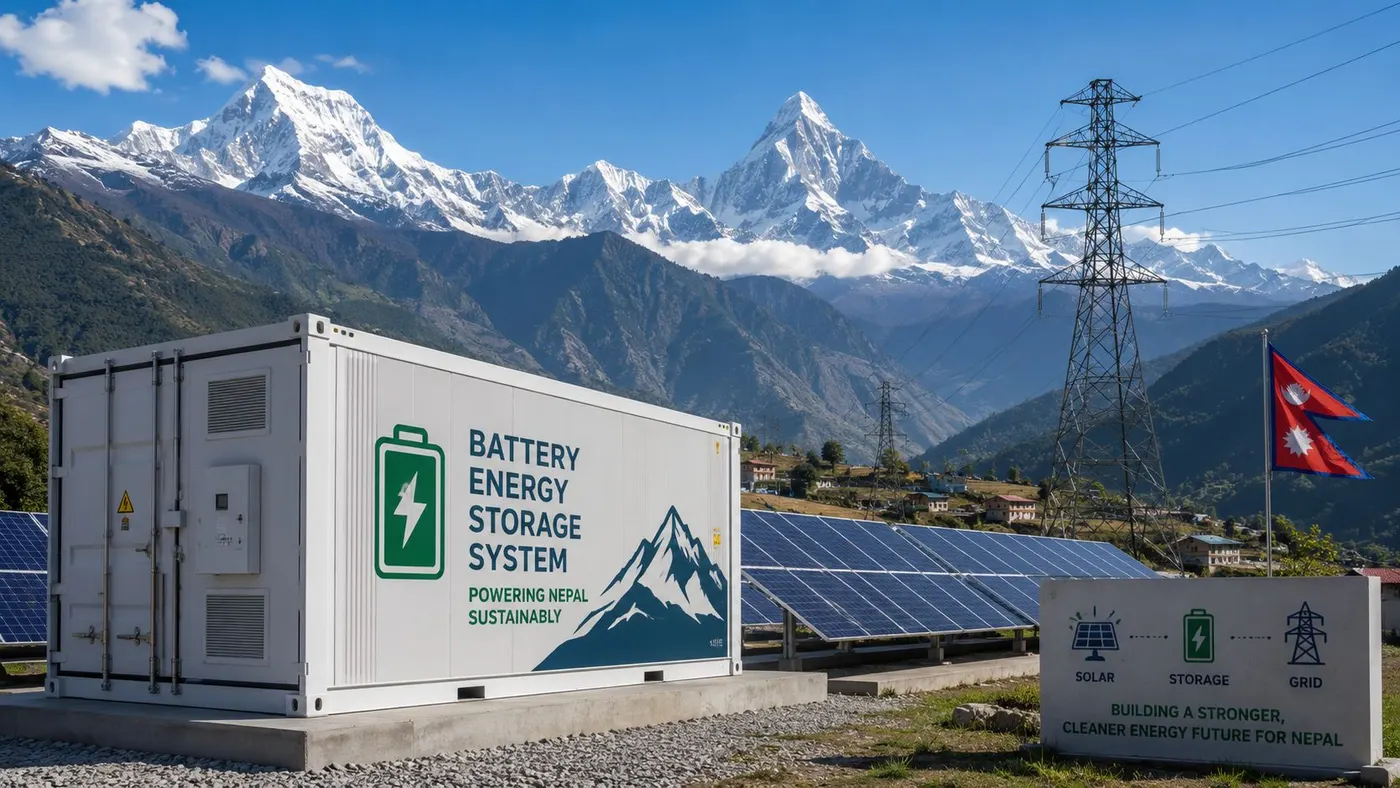
Nepal is often described as a hydropower-rich country, and rightly so. Most of our electricity generation comes from water. But if we look closely at how the grid behaves throughout the year, the challenge is no longer only about generating more electricity. It is also about when, where, and how reliably that electricity is available.
During the monsoon, Nepal can have surplus electricity. During the dry season, generation drops and imports may become necessary. Evening peak demand arrives exactly when solar power starts disappearing. Industries face demand charges. EV charging is growing. Remote districts still need reliable power. This is where Battery Energy Storage Systems (BESS) become important.
A BESS stores electricity when it is available, cheap, or unused, and releases it when it is needed most. For Nepal, battery storage can become the missing link between hydropower, solar energy, electric mobility, industrial reliability, and a stronger grid — storage is one of the areas covered under renewable energy engineering more broadly.
What is a Battery Energy Storage System?
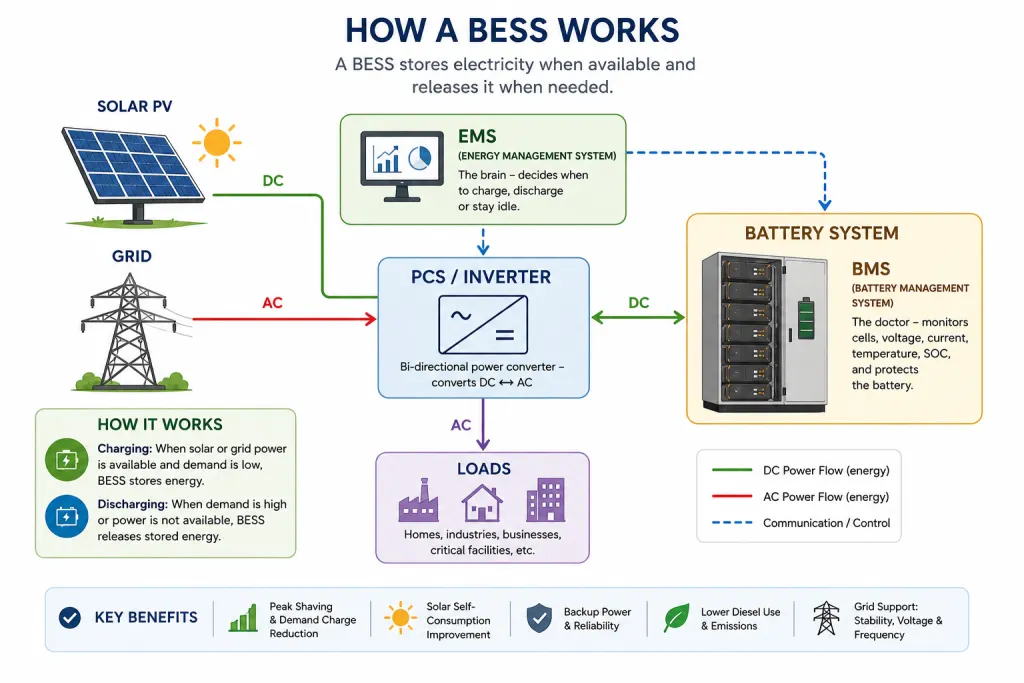
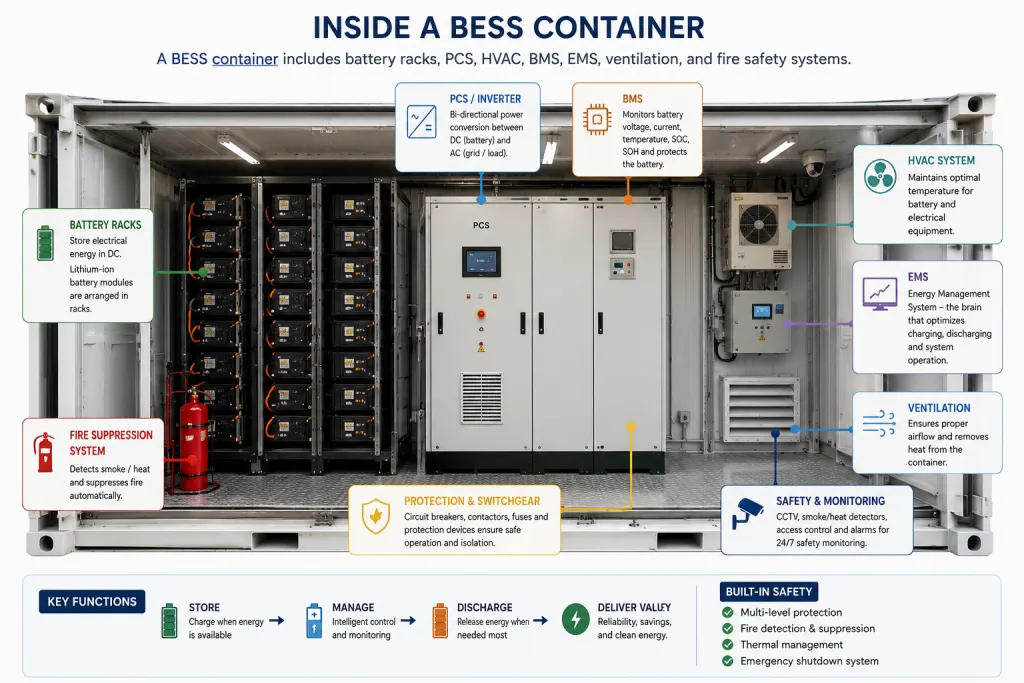
A Battery Energy Storage System is not just a battery. It is a complete system made up of:
- battery cells, modules, racks, or cabinets;
- Battery Management System (BMS);
- Power Conversion System (PCS) or bidirectional inverter;
- Energy Management System (EMS);
- HVAC or thermal management;
- Protection, fire detection, and safety systems.
The battery stores energy in DC form. The PCS converts electricity between DC and AC. The BMS protects the battery by monitoring voltage, current, temperature, State of Charge (SOC), and State of Health (SOH). The EMS decides when the battery should charge, discharge, or stay idle.
In simple terms:
Battery = storage PCS = power converter BMS = safety monitor EMS = control brain
Why does Nepal need BESS if we already have hydropower?
This is the most common question. Nepal has hydropower, but hydropower alone does not solve every grid problem.
1. Seasonal mismatch
Most hydropower plants in Nepal are run-of-river projects. They generate more electricity during the monsoon and less during the dry season. BESS cannot replace large seasonal storage like reservoirs or pumped storage, but it can help manage hourly and daily mismatch.
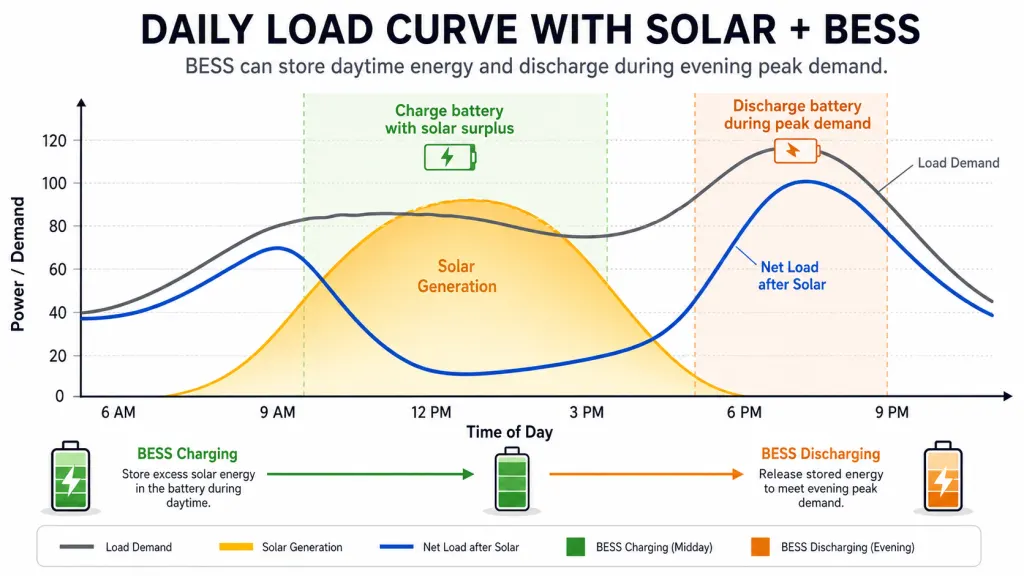
For example, a battery can charge when solar or hydropower is available and discharge during evening peak hours.
2. Evening peak demand
Electricity demand usually rises in the evening when people return home, industries continue operating, and lighting, cooking, and appliances are used. At the same time, solar generation falls to zero.
This creates a peak-hour pressure on the grid. BESS can discharge during these peak hours and reduce stress on the system.
3. Transmission congestion
Sometimes electricity is available in one location but cannot be moved easily to another location because of transmission limitations. Distributed batteries placed near load centers can help reduce pressure on transmission and distribution networks.
BESS will not replace transmission lines, but it can support the grid where expansion takes time.
4. Growth of solar energy
Nepal is gradually adding more solar power. Solar is useful because it can be deployed faster than large hydropower projects. But solar power is variable. It produces during the day and stops at night.
BESS helps solar become more useful by storing daytime energy for evening use.
5. EV charging growth
As electric vehicles grow in Nepal, EV fast charging will create sharp demand peaks. A fast charger can draw high power instantly. If many chargers operate at once, weak feeders may become overloaded.
Battery storage can act as a buffer between EV chargers and the grid. It can charge slowly from the grid and discharge quickly when vehicles need fast charging.
6. Remote and high-altitude reliability
Remote districts such as Mugu, Jumla, Dolpa, and Humla face difficult terrain, high altitude, cold temperature, and weak grid access. Solar-plus-BESS can support reliable electricity in such locations, especially where diesel transport is expensive and difficult.
Where can BESS be used in Nepal?
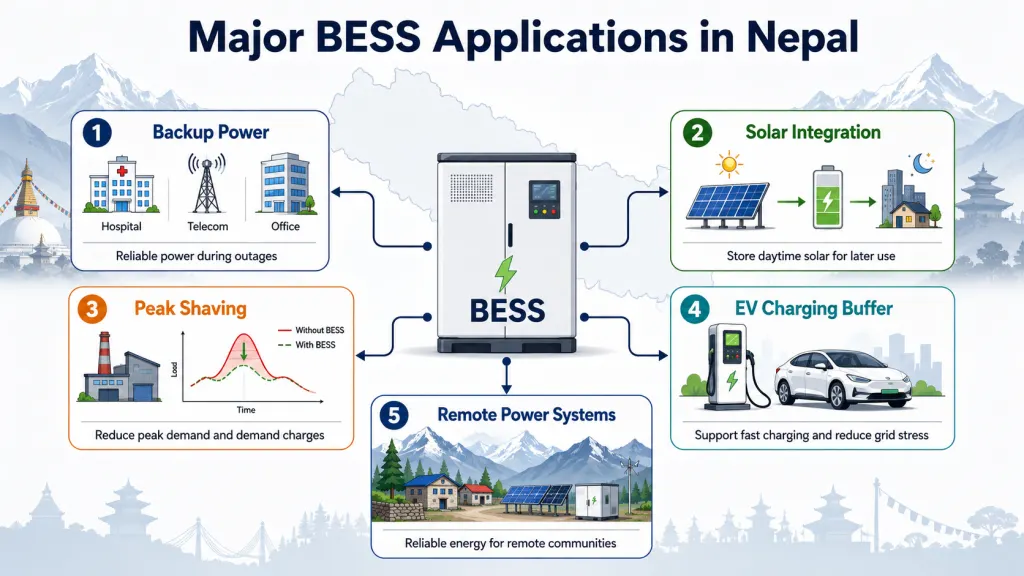
BESS has many possible applications in Nepal.
| Backup power | Hospitals, telecom towers, banks, data centers |
|---|---|
| Peak shaving | Factories, malls, hotels, commercial buildings |
| Solar self-consumption | Rooftop solar at colleges, industries, offices |
| EV charging buffer | Highway chargers and urban charging hubs |
| Remote mini-grids | Karnali and mountain districts |
| Grid support | Weak feeders, substations, voltage and frequency support |
| Diesel replacement | Industries and institutions using generators |
BESS and Nepal’s policy direction
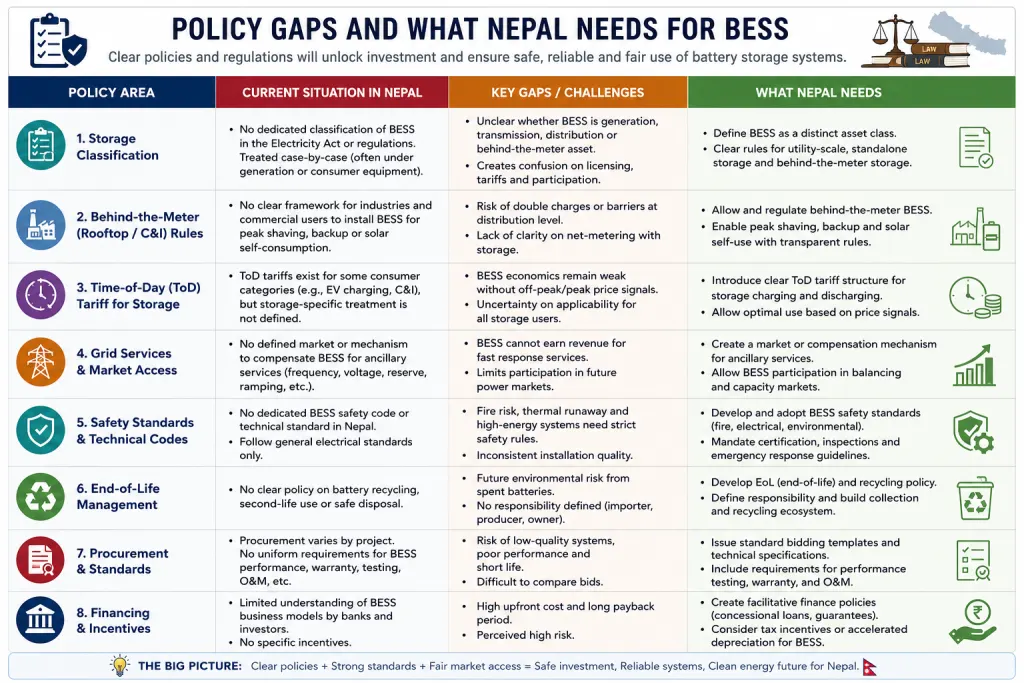
Nepal’s policy and regulatory framework for storage is still developing. Hydropower, solar, transmission, and distribution already have clearer rules, but BESS still needs more specific treatment.
Some important policy questions are:
1. How should BESS be classified?
Is BESS a generation asset, transmission asset, distribution asset, or consumer-side equipment? This matters because classification affects licensing, ownership, tariffs, and grid connection.
2. Can industries install batteries behind the meter?
Commercial and industrial consumers may want to install BESS for peak shaving, backup, and solar self-consumption. Clear rules are needed so that industries can confidently invest in storage.
3. How should Time-of-Day tariffs support storage?
BESS becomes more financially attractive when electricity prices are different at different times of day. If off-peak electricity is cheaper and peak electricity is expensive, batteries can charge during low-cost hours and discharge during high-cost hours.
Nepal already has Time-of-Day tariff structures for some consumer categories, but storage-specific rules can make the business case clearer.
4. Can batteries be paid for grid services?
BESS can respond quickly. It can support frequency regulation, voltage control, peak management, and grid reliability. But for this to become a business model, Nepal needs a mechanism to pay storage owners for such services.
5. What safety standards should be required?
Battery systems need clear safety requirements. Procurement documents should specify battery chemistry, cycle life, altitude derating, fire detection, ventilation, emergency shutdown, BMS protection, warranty, and installation standards.
6. What happens at end of life?
As battery deployment increases, Nepal will also need rules for battery recycling, disposal, and second-life use.
The economics of BESS: where does the money come from?
A BESS is not automatically profitable. It depends on the site, tariff, load profile, battery cost, and the value streams it can capture.
For a commercial or industrial project, possible savings may come from:
- reducing demand charges;
- shifting energy from off-peak to peak hours;
- replacing diesel generator use;
- increasing solar self-consumption;
- avoiding outage losses;
- improving power reliability;
- future grid service revenue.
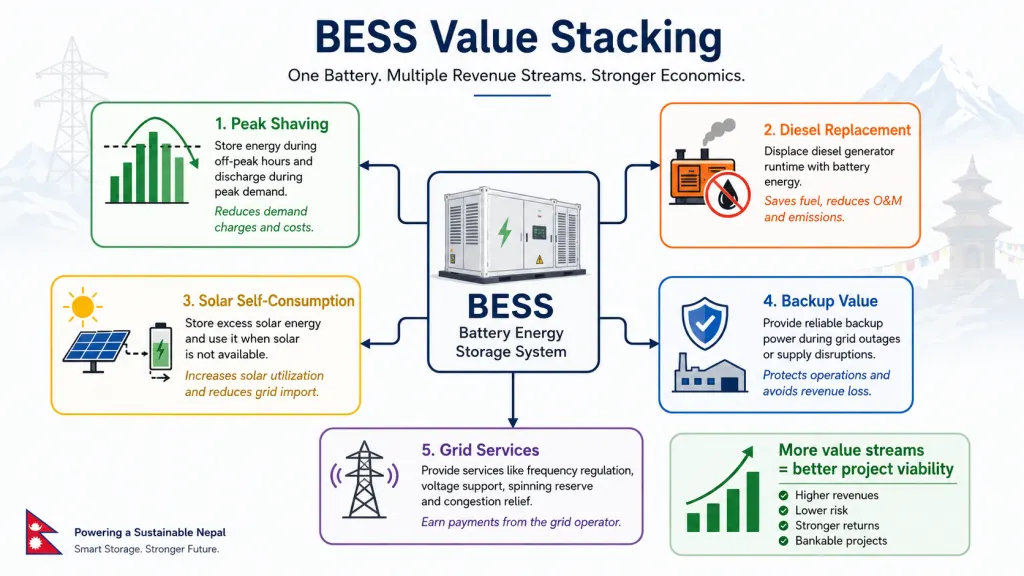
The most important idea is value stacking.
A battery becomes financially attractive when the same system earns value from multiple services. For example, a factory battery may provide backup during outages, reduce peak demand, use more rooftop solar, and reduce diesel consumption.
If a battery is used for only one small benefit, the payback may be too long. But when several benefits are combined, the business case improves.
CAPEX, OPEX, payback, and LCOS in simple language
To evaluate a BESS project, engineers and investors typically consider four financial questions — the same kind of framework covered under techno-economic modelling for renewable energy projects generally.
1. CAPEX: What does it cost to build?
CAPEX includes battery modules, PCS/inverter, BMS, EMS, HVAC, fire protection, cables, switchgear, civil works, installation, and commissioning.
2. OPEX: What does it cost to operate?
OPEX includes maintenance, monitoring, HVAC electricity, insurance, inspections, replacement parts, and technical service.
3. Payback: When does the investment return?
Simple payback is calculated as:
Payback = Total investment / Annual net saving
If the battery costs NPR 10 million and saves NPR 1 million per year, the simple payback is about 10 years.
4. LCOS: What is the lifetime cost of stored electricity?
LCOS means Levelized Cost of Storage. It estimates the cost of each kWh delivered by the battery over its lifetime.
A lower LCOS means the battery is more cost-effective over time.
Safety cannot be an afterthought
Battery systems are powerful electrical systems. Safety must be included from the beginning of design.
Key safety concerns include:
- thermal runaway;
- overcharge and over-discharge;
- short circuit;
- overheating;
- fire and smoke;
- gas buildup;
- poor ventilation;
- weak installation practices;
- lack of emergency response planning.
For Nepal, safety is especially important because many sites may be remote, dusty, hot, cold, or located at high altitude.
A good BESS project should include:
- reliable BMS;
- proper ventilation and HVAC;
- smoke, heat, and gas detection;
- fire suppression system;
- electrical protection;
- safe spacing and access;
- emergency shutdown;
- trained operators;
- O&M logs and inspections.
The skills gap: Nepal needs trained BESS engineers
One of the biggest barriers to BESS deployment in Nepal is not only technology or finance. It is human resource capacity.
Engineers and technicians need to understand:
- battery chemistry;
- kW vs kWh;
- SOC, SOH, DoD, C-rate, and RTE;
- battery sizing;
- PCS sizing;
- voltage and current matching;
- datasheet reading;
- BMS, PCS, EMS, and HVAC;
- CAPEX and payback;
- safety and O&M;
- grid and solar integration.
This is why BESS education is important now.
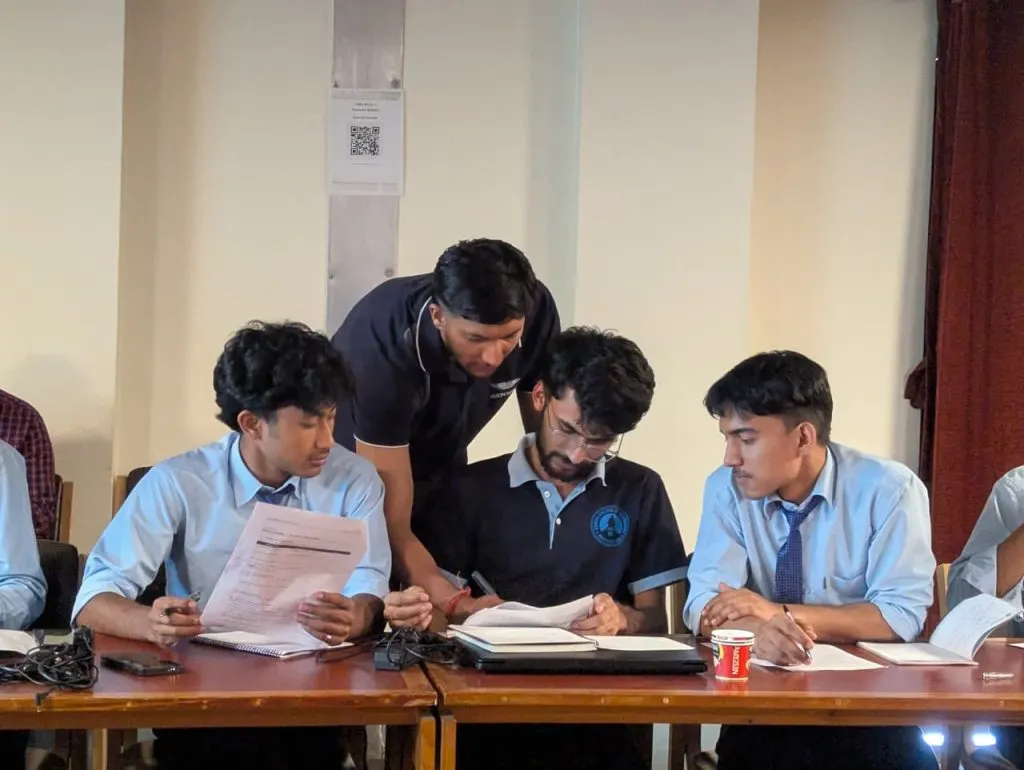
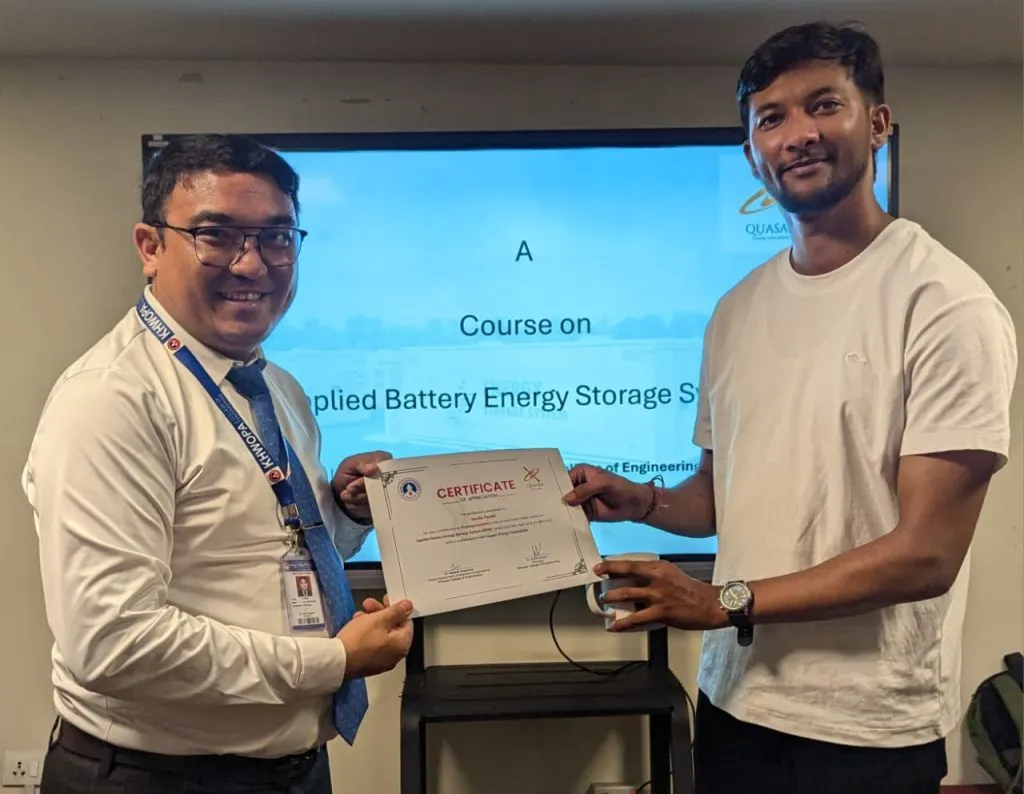
Recently, Quasar Energy Consultants conducted an Applied Battery Energy Storage Systems training in collaboration with Khwopa College of Engineering. The training introduced engineering students to Nepal’s energy context, BESS fundamentals, battery technologies, system architecture, datasheet reading, sizing, economics, integration, safety, O&M, and final design exercises.
For Nepal to deploy BESS properly, we need more engineers who can not only explain battery storage but also design, size, evaluate, install, and maintain it.
Challenges for BESS in Nepal
BESS has strong potential, but several challenges remain.
High upfront cost
Battery systems are still expensive for many consumers. Even if lifetime savings are attractive, the initial investment can be difficult.
Limited financing understanding
Banks and investors may not yet be familiar with BESS revenue models. This can make financing harder.
Lack of clear regulation
Storage-specific rules are still needed for licensing, tariffs, ownership, grid connection, and grid services.
Technical design complexity
BESS design is not just battery selection. Engineers must consider voltage windows, current limits, PCS sizing, thermal management, altitude, safety systems, and control logic.
Safety and emergency response
Fire safety, emergency shutdown, operator training, and response procedures must be taken seriously.
End-of-life management
Battery recycling and disposal policies will become increasingly important as deployment grows.
What Nepal should do next
To support responsible BESS growth, Nepal should focus on:
- creating clear storage policies and grid connection rules;
- defining how BESS can participate in the electricity market;
- encouraging industries to use BESS for peak shaving and backup;
- supporting solar-plus-storage projects;
- developing technical standards for safety and installation;
- training engineers, technicians, and operators;
- encouraging banks to understand BESS project finance;
- planning recycling and end-of-life systems early.
BESS should not be treated as just another battery purchase. It should be treated as a grid flexibility asset.
Conclusion: BESS is not just a battery
Nepal’s energy future will not be built by hydropower alone. It will need hydropower, solar power, transmission lines, electric vehicles, digital loads, and storage working together.
Battery Energy Storage Systems are not a replacement for Nepal’s hydropower strength. They are a tool to make that strength more flexible, reliable, and valuable.
For Nepal, BESS can support peak demand, improve reliability, reduce diesel use, integrate solar energy, buffer EV charging, and strengthen remote power systems.
The technology is ready. The need is growing. The policy is still catching up. And the most important work now is to build people who understand how to design, operate, and manage these systems safely.
That is where Nepal’s BESS journey truly begins.
Frequently Asked Questions
What is BESS?
BESS stands for Battery Energy Storage System. It stores electricity and releases it when needed.
Why does Nepal need BESS?
Nepal needs BESS to manage peak demand, dry-season shortages, solar integration, EV charging, remote reliability, and backup power.
Is BESS useful even though Nepal has hydropower?
Yes. Hydropower provides energy, but BESS provides flexibility. It helps shift electricity from one time to another.
Where can BESS be used in Nepal?
BESS can be used in hospitals, industries, telecom towers, data centers, EV charging stations, solar plants, remote mini-grids, and weak grid areas.
Is BESS financially viable in Nepal?
It depends on the project. BESS becomes more viable when multiple value streams are combined, such as diesel replacement, demand-charge reduction, solar self-consumption, and backup value.
What is the main challenge for BESS in Nepal?
The main challenges are high upfront cost, unclear policy, limited trained manpower, safety requirements, and lack of financing familiarity.
Disclaimer
This article is for general educational purposes. Project capacities, tariffs, policy provisions, and regulatory details may change over time. Readers should verify official figures from NEA, ERC, DoED, MoEWRI, and other relevant authorities before making technical or investment decisions.