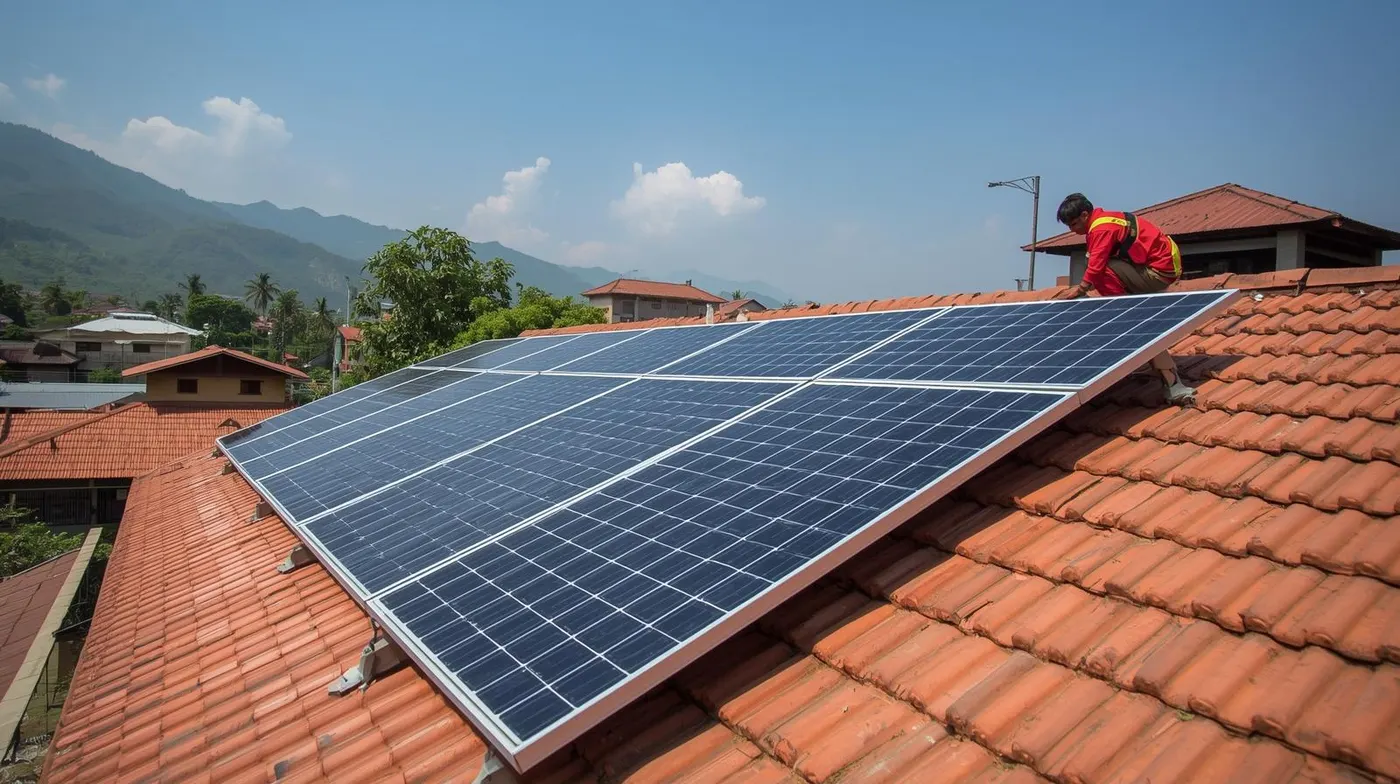
Solar financing in Nepal has grown quickly in recent years. Both government programs and private-sector companies play a role in helping households, businesses, and rural communities adopt solar energy. The Alternative Energy Promotion Centre supports off-grid and rural projects, while banks and private investors increasingly support commercial and urban systems. Below is a clear overview of how solar financing works in Nepal — the financing side of what a solar PV feasibility study has to account for.
CAPEX Model (Capital Expenditure)
This is the most common model in Nepal. In this model, the customer pays the full upfront cost to buy and install the solar system. The customer becomes the owner and is responsible for operation and maintenance. Financing usually comes from personal savings or bank loans. This model is widely used by homeowners and industries that want to benefit from tax depreciation and have the capital available.
As of 2025, the typical investment cost for grid-connected rooftop solar in Nepal ranges approximately 50,000 per kWp, depending on system size and quality of components. Commercial users can also benefit from accelerated depreciation, significantly reducing taxable income in the early years. Under current electricity tariffs, most CAPEX-based systems achieve a payback period of approximately 5 to 7 years, after which electricity is effectively produced at a very low marginal cost.
RESCO or OPEX Model (Renewable Energy Service Company)
This model is becoming popular among commercial and industrial users. A third-party company (the RESCO) invests in, installs, and maintains the solar plant on the customer’s roof or premises. The customer does not pay for the equipment but instead signs a Power Purchase Agreement (PPA) to buy the electricity generated at a tariff lower than the grid rate (NEA rate) for a fixed tenure (e.g., 10-15 years). Companies such as Gham Power through Gham Urja Sewa are active in this sector. The customer gets affordable energy without any upfront cost, while the RESCO earns long-term revenue.
The RESCO model is particularly attractive for businesses seeking to reduce operating expenses without committing capital. All operational and performance risks, including maintenance and equipment replacement, are borne by the RESCO. While the customer shares part of the savings through the agreed PPA tariff, the arrangement allows immediate cost reduction, predictable energy pricing, and balance-sheet flexibility, making it suitable for capital-constrained or risk-averse organizations.
PAYG Model (Pay As You Go)
This model helps rural households and farmers who cannot afford a large upfront payment. Users pay small daily, weekly, or monthly amounts using mobile money or scratch cards. The system features a remote lock function that activates only after payment has been made. It is widely used for solar home systems and solar water pumps. Companies like Gham Power have used this model in the past.
In most PAYG arrangements, system ownership is transferred to the user after all scheduled payments are completed. This model effectively replaces traditional credit mechanisms, enabling financial inclusion for households and farmers without access to formal banking. PAYG has been especially impactful in financing solar home systems and solar water pumps, where income streams are seasonal and upfront affordability remains a major barrier.
Community Owned or Microgrid Model
Communities form cooperatives and invest in building a microgrid. They may contribute cash, labour, or land. These projects often receive subsidies and grants from AEPC and development partners. The community manages billing and maintenance.
These projects are typically governed by local cooperatives responsible for tariff setting, revenue collection, and routine maintenance. By blending community equity with government subsidies and donor grants, microgrids provide a sustainable solution for areas with weak or nonexistent grid infrastructure, while also fostering local ownership and accountability.
Financing Mechanisms in Nepal
Government Subsidies and Viability Gap Funding
Under the Renewable Energy Subsidy Policy 2079, AEPC provides grants for off-grid technologies such as solar home systems, solar water pumps, and solar cookers. These subsidies focus on remote areas without grid access. For projects that are close to being commercially viable, the Sustainable Energy Challenge Fund offers viability gap funding. This financial support helps make projects profitable for private investors.
In practice, AEPC subsidies are primarily targeted toward off-grid and productive-use applications, while grid-connected commercial projects rely more on financial instruments such as viability gap funding and interest rate buy-downs. These mechanisms help bridge the gap between commercial bank lending terms and project cash flows, improving bankability without distorting market pricing.
Commercial Bank Loans
The Nepal Rastra Bank requires banks to allocate part of their loan portfolio to the energy sector. This has led to the introduction of green financing products.
Currently, renewable energy loans in Nepal typically carry interest rates in the range of 10% to 13%, with loan tenures between 5 and 10 years. Banks generally assess project bankability using indicators such as the Debt Service Coverage Ratio (DSCR), often requiring a minimum DSCR of around 1.25 to ensure sufficient cash flow for debt repayment — the same bankability question technical due diligence is built to answer for a lender.
Examples include
Global IME Bank is offering Global Green SME loans, and NMB Bank also offers rooftop solar loans with concessional interest rates. Some vendors also work directly with banks to arrange financing for customers. In these cases, the bank pays the vendor once the loan is approved.
Private Equity and Venture Capital
Large solar projects and solar companies often receive investments from private equity and venture capital funds. Dolma Impact Fund invests in utility-scale solar and renewable technology, and also One to Watch has invested in off-grid systems.
Project Economics – Does Solar Make Financial Sense in Nepal?
The financial viability of solar projects in Nepal is typically assessed using indicators such as Payback Period, Internal Rate of Return (IRR), and Levelized Cost of Energy (LCOE). Most commercially designed rooftop solar projects achieve an IRR exceeding 15%, which is higher than returns from conventional fixed-income instruments. The LCOE of solar in Nepal generally falls between NPR 4 and 7 per kWh, significantly lower than the average NEA grid tariff of around NPR 10.50 per kWh. Financial models also account for inverter replacement costs around years 10 to 12, ensuring realistic long-term projections. This is exactly the kind of analysis covered under techno-economic modelling — linking engineering assumptions to payback, IRR and LCOE rather than treating them separately.
Net Metering as a Key Policy Enabler
Net metering plays a critical role in improving the economics of grid-connected solar systems. Under this mechanism, surplus electricity generated by a solar system is exported to the national grid and credited against the consumer’s electricity bill. In Nepal, net metering is currently available for systems ranging from 10 kW up to 500 kW, with annual export typically capped relative to total consumption. While export credits are lower than import tariffs, net metering ensures that excess generation is monetized rather than wasted, significantly improving project returns.
Conclusion
Solar financing in Nepal is diverse and expanding. Households rely mostly on the CAPEX model, while commercial and industrial users are adopting RESCO models. Rural communities benefit from PAYG systems and community-owned microgrids. Government subsidies, concessional bank loans, and private investment together make solar energy more accessible across the country.
As costs continue to decline and financial mechanisms mature, solar energy in Nepal is increasingly viewed not just as an energy solution but as a strategic tool for cost optimization and long-term asset creation.
Frequently asked
Which solar financing model requires no upfront cost from the customer? The RESCO (OPEX) model. A third-party company invests in, installs, and maintains the system, and the customer simply buys the electricity it produces through a Power Purchase Agreement, typically at a tariff below the grid rate.
What’s a typical payback period for a CAPEX-financed rooftop solar system in Nepal? Approximately 5 to 7 years under current electricity tariffs, with commercial users able to benefit from accelerated depreciation in the early years.
Why does net metering matter for solar project economics? It lets surplus electricity generated by a solar system be exported to the grid and credited against the consumer’s bill, rather than wasted — available in Nepal for systems from 10 kW up to 500 kW, and a significant factor in improving project returns even though export credits are lower than import tariffs.