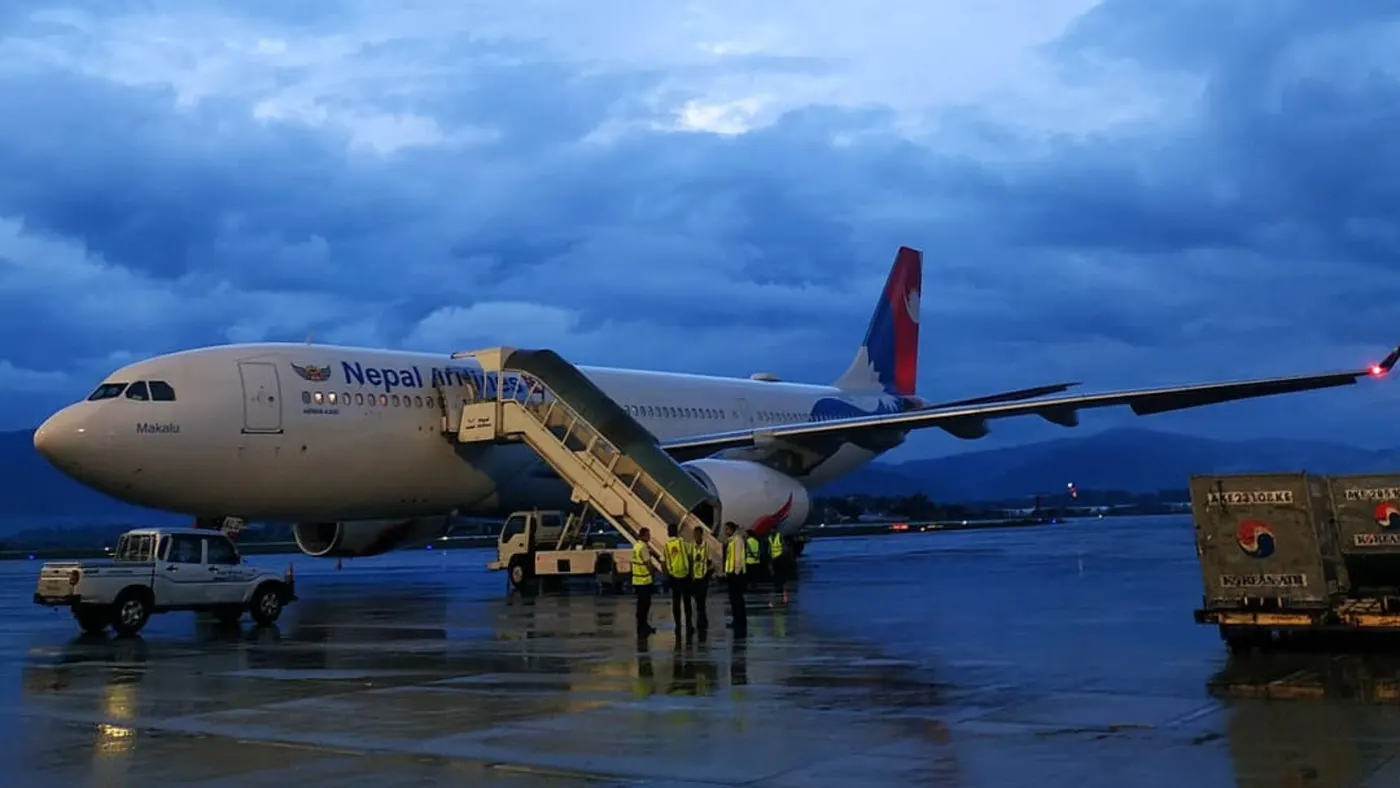
Aviation plays a crucial role in Nepal’s transportation sector, especially due to its mountainous terrain, which makes connecting remote communities and regions with the rest of the country difficult using other means of transportation. The commercial aviation industry in Nepal started in the 1950s, and since then, it has grown significantly. Nepal Airlines, the national flag carrier, and private airlines such as Yeti Airlines, Buddha Air, and Simrik Airlines offer regular flights to various destinations within Nepal, connecting cities and rural areas.
Despite the challenging geographical conditions, Nepal’s aviation industry has made remarkable progress over the years. The country has several airports, including the famous Tribhuvan International Airport in Kathmandu, which connects Nepal with major cities in Asia, Europe, and the Middle East.
However, the Nepali aviation sector has encountered various challenges in recent years. The industry requires proper infrastructure, upgraded technology, and better maintenance facilities to overcome these challenges. The recent surge in air traffic has put pressure on the country’s airports, which are struggling to keep up with the growing demand.
In recent years, the Nepali government has taken steps to modernize the aviation sector and improve its infrastructure. The government has introduced several measures to enhance safety and security, such as investing in new equipment and technology and improving runway facilities.
Nepal currently has 33 operational airports, with another 5 under construction. Meanwhile, 19 airports are inactive. The country has three international airports: Kathmandu’s Tribhuwan International Airport, Bhairahawa’s Gautam Buddha International Airport, and Pokhara’s Pokhara International Airport.
In recent years, the Nepali government has taken steps to modernize the aviation industry. With continued investment and improvement, the sector is poised for even greater growth and development in the future.
Bilateral Air Services Agreements between Nepal and 40 Countries
Since 1963, Nepal has signed bilateral air services agreements and memoranda of understanding (MoUs) with 40 different countries. In 1992, Nepal adopted a liberal sky policy and since then has been gradually pursuing an open sky policy as outlined in the 2006 Civil Aviation Policy. The provisions of the agreements with these countries outline the available routes, capacity for Nepalese carriers, destinations they are authorized to serve, and the number of weekly and yearly seats they are permitted.
These agreements were signed between 1989 and 2015, with a majority signed in the late 1990s and early 2000s, covering a range of countries from Austria to the Netherlands. Some countries have multiple designations, while others have a single one. The number of weekly and yearly seats permitted varies greatly based on the agreement and country.
The History of Aviation in Nepal
Timeline of Aviation Development in Nepal:
- 1949 — The first aircraft, a Beechcraft Bonanza, lands in Nepal carrying the Indian ambassador.
- 1967 — The first jet, a Lufthansa Boeing 707, lands at Tribhuvan International Airport.
- 1972 — Royal Nepal Airlines commences jet operations with a Boeing 727.
- 1992 — Nepal adopts a liberal sky policy.
- 2006 — Civil Aviation Policy 2006 was implemented in line with the open-sky policy.
- 1963-present — Nepal signs bilateral air service agreements with 39 countries.
- 2023 — 56 airports in Nepal, 50 fully built and 6 under construction.
- Present — The global aviation industry is on a high-growth trajectory, with Nepal working to improve its air infrastructure and implement relevant legislation.
Nepal Airlines aims to improve its competitiveness by adding aircraft to its fleet and increasing international destinations. The government plans to have one airport in every province and increase bilateral air service agreements to 42, allowing Nepal Airlines to play a role in promoting the national economy through aviation diplomacy.
Airlines Company in Nepal
List of airlines in Nepal:
Fixed-wing aircraft:
A fixed-wing aircraft is an aircraft that is capable of flight using forward-facing wings that are rigid and do not change shape during flight. These aircraft rely on the lift generated by their wings to stay aloft and fly through the air — the same aerodynamic lift analysis behind CFD simulation work more generally. They are powered by one or more engines and have a relatively long range, making them ideal for commercial air travel. Examples of fixed-wing aircraft include commercial airliners, military jets, and general aviation aircraft.
- Buddha Air Pvt. Ltd. — two Beechcraft 1900D (B1900D), nine ATR 72-500, and three ATR 42-320 aircraft.
- Guna Airlines — five Jetstream 4100s and two Beechcraft 1900C domestic aircraft.
- Nepal Airlines Corporation — 2 Airbus A330-200 (engine RR Trent 772B-60, registrations 9N-ALY and 9N-ALZ, named “Annapurna” and “Makalu”); 2 Airbus A320-200 (engines IAE V2527E-A5 and RR Trent 772B-60, registrations 9N-AKW and 9N-AKX); 2 Xian MA60 (engine PW100, registrations 9N-AKQ and 9N-AKR); 4 Harbin Y12E (engine PWC PT6A-135A, registrations 9N-AKS, 9N-AKT, 9N-AKU, and 9N-AKV); 3 Twin Otter DHC-6-300 (engine PW PT6, registrations 9N-ABT, 9N-ABU, and 9N-ABX).
- Shree Airlines Pvt. Ltd. — 8 aircraft as of February 2023: 2 Bombardier CRJ200s (50 seats each), 2 Bombardier CRJ700s (70 seats each), and 4 Bombardier Dash 8 Q400 (80 seats each).
- Sita Air Pvt. Ltd. — 4 Dornier Do-228 (19 passengers per aircraft), as of February 2023.
- Summit Air Pvt. Ltd. — 4 aircraft as of February 2023: 2 Cessna Grand Caravan (9-seater), 1 LET 410 UVP-E20 (18 seats), and 1 LET 410 Russian-made 18-seater.
- Saurya Airlines Pvt. Ltd. — a fleet of three CRJ-200 aircraft.
- Tara Air Pvt. Ltd. — three STOL aircraft, including the Twin Otter DHC-6/400 and DHC-6/300.
- Yeti Airlines Pvt. Ltd. — six ATR 72-500 aircraft with a 60-seat capacity.
- Himalaya Airlines — four aircraft: three Airbus 320-214 and one Airbus 319-115, all with an all-economy seating configuration.
Rotary-wing aircraft:
Rotary wing aircraft, also known as helicopters, are aircraft that can take off and land vertically, hover in one spot, and fly forward, backward, and laterally. Unlike fixed-wing aircraft, rotary-wing aircraft use rotors for lift and propulsion, allowing for more versatility in terms of landing and takeoff locations.
- Air Dynasty Heli Services Pvt. Ltd.
- Altitude Air Pvt. Ltd.
- Fishtail Air Pvt. Ltd.
- Heli Everest Pvt. Ltd.
- Kailash Helicopter Services Pvt. Ltd.
- Manang Air Pvt. Ltd.
- Mountain Helicopters Pvt. Ltd.
- Mustang Helicopter Pvt. Ltd.
- Prabhu Helicopters Pvt. Ltd.
- Simrik Air Pvt. Ltd.
Challenges and Issues in the Aviation Industry of Nepal
The aviation industry in Nepal is facing several issues such as the lag in infrastructure development, which has not kept up with the increase in air traffic. There is also an increase in congestion at airports, fierce competition for fares between airlines, and a decrease in safety records. Since 2000, there have been at least 350 casualties associated with airplanes or helicopters, which has raised questions about the effectiveness of the country’s aviation safety regulations.
The Civil Aviation Authority of Nepal is responsible for regulating the industry, but it performs dual functions as a regulator and a service provider. This has been criticized by industry experts and global aviation watchdogs. In 2013, the European Union banned all Nepali airlines from operating in its airspace due to safety concerns, and the ban has not yet been lifted. Although Nepal has made efforts to improve safety, the safety record still does not match the requirements of other civil aviation authorities. Recently, the European Commission has extended the ban on Nepali airlines and questioned the dual role of the Civil Aviation Authority. However, the government has not shown any interest in splitting the organization into two entities to enhance the safety of flyers. This kind of independent regulatory and technical scrutiny is the same territory covered by mechanical engineering work in Nepal more broadly — aerospace remains one of the more limited-opportunity fields locally.
Frequently asked
How many airports does Nepal have? 33 operational airports as of this writing, with another 5 under construction and 19 inactive — including three international airports at Kathmandu, Bhairahawa, and Pokhara.
Why was Nepal’s aviation industry banned from EU airspace? The European Union banned all Nepali airlines from its airspace in 2013 over safety concerns, and the ban remains in place. It has been linked partly to the Civil Aviation Authority of Nepal’s dual role as both regulator and service provider.
How many countries does Nepal have bilateral air service agreements with? 40 countries, under agreements and MoUs signed since 1963, mostly in the late 1990s and early 2000s, following Nepal’s adoption of a liberal sky policy in 1992.
Disclaimer: This blog presents information about aviation based on research and personal interpretation. I am not a professional aviation expert, and the information provided may not be entirely accurate. It is the reader’s responsibility to fact-check and verify the information before using it for any project or work. I assume no liability for any errors or inaccuracies in the content.