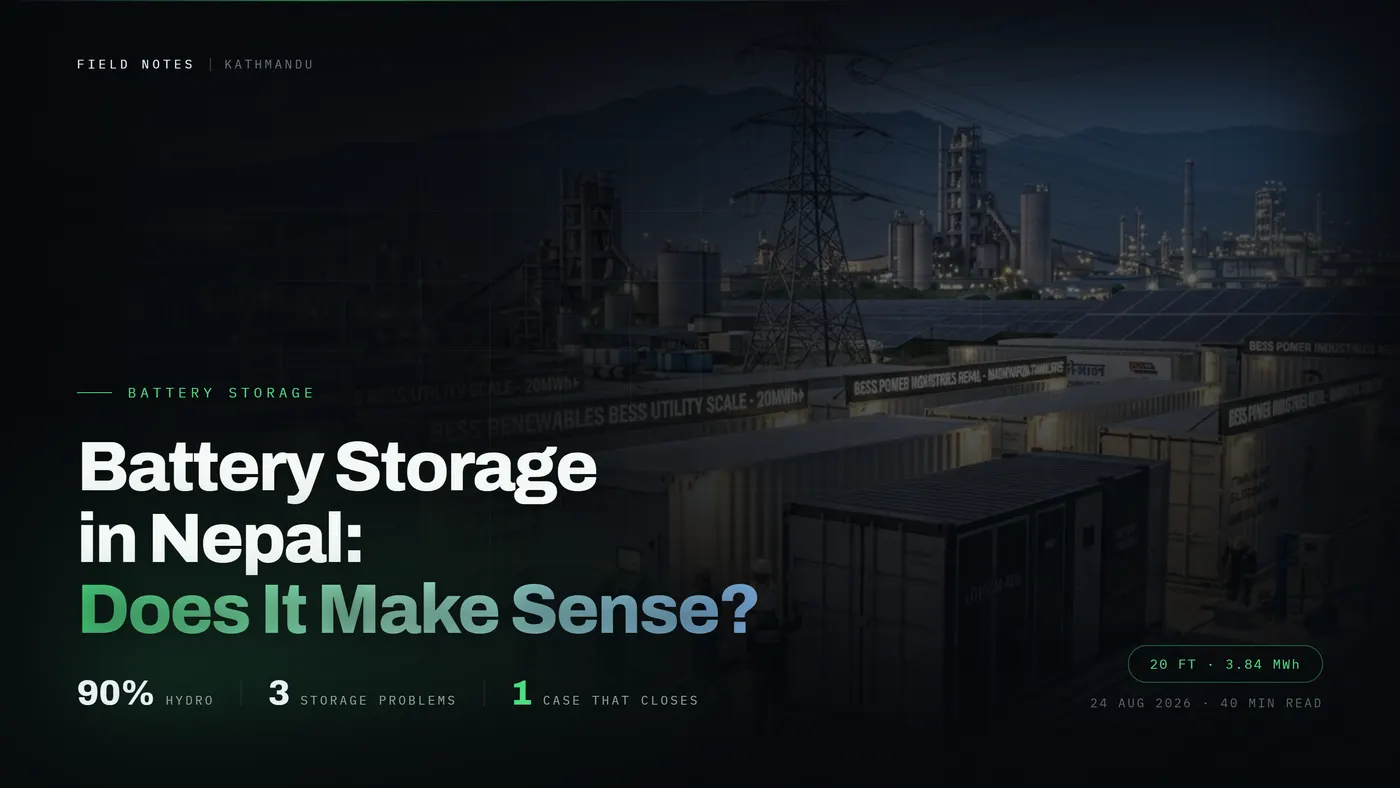
Hi, I’m Sandip Paudel, a renewable energy engineer based in Kathmandu. Battery storage is a technology I’m actively exploring and learning right now, from the training work described further down this page to the arithmetic worked through below, and this post is where that learning currently stands.
Nepal generates over 90 per cent of its electricity from water. So the first honest reaction to “battery storage for Nepal” is scepticism. Why would a country sitting on a hydropower resource measured in tens of gigawatts spend money on lithium cells imported from China?
I had that reaction too. Then I spent a year building a BESS training curriculum, working through system designs against real Nepali tariffs and site constraints, and reading NEA’s annual report line by line. The answer turned out to be more interesting than either “yes obviously” or “no, build reservoirs instead.”
The short version: Nepal does not have one storage problem. It has three, they need different answers, and only one of them has a business case that closes today.
Nepal’s problem is not a shortage of energy
Nepal’s grid runs a surplus and a deficit in the same year, sometimes in the same week.
From NEA’s own annual report for FY 2081/82 (2024/25):
| Metric | Value |
|---|---|
| Peak system demand | 2,901 MW (Ashadh) |
| Peak national demand | 2,409 MW (Jestha) |
| Energy exported to India | 2,331.7 GWh |
| Energy imported from India | 1,711.5 GWh |
| Average selling price | NPR 9.44 per kWh |
| Distribution loss | 10.39 per cent |
Look at that export and import row together. In one fiscal year, Nepal shipped out 2,332 GWh and bought back 1,712 GWh. The country is not short of electricity in aggregate. It is short of electricity at the right time.
There is a more uncomfortable number buried in the same report. NEA’s monthly capacity balance carries a line labelled “interruption.” For FY 2081/82 it reads: 350 MW in Mangsir, 350 MW in Poush, 300 MW in Magh, 350 MW in Falgun, 370 MW in Chaitra, 400 MW in Baishakh. That is roughly 300 to 400 MW of demand that the system did not serve during the dry season. Call it managed load, call it interruptible industrial supply, call it whatever the tariff schedule calls it. Functionally it is unmet demand sitting on the balance sheet of a utility that exported 2,332 GWh three months earlier.
IPPAN’s vice president Ashish Garg put the wet season side of it plainly in a February 2026 piece: during the wet season of 2025, surplus generation reached about 1,400 MW against an Indian export approval of 1,141 MW, and the difference spilled, mostly at NEA’s own power stations. In November 2025, 25 industries with a combined 300 MW of demand were disconnected in a dispute over dedicated trunk line charges, which forced hydropower projects to shut down because the power had nowhere to go. In January 2026, after years without load shedding, morning and evening residential cuts came back.
His summary is the sharpest framing I have read: Nepal’s power system depends on the Indian market so heavily that India is functioning as Nepal’s battery. When Indian scheduling does not accommodate a Nepali variation, the result is either spillage or load shedding.
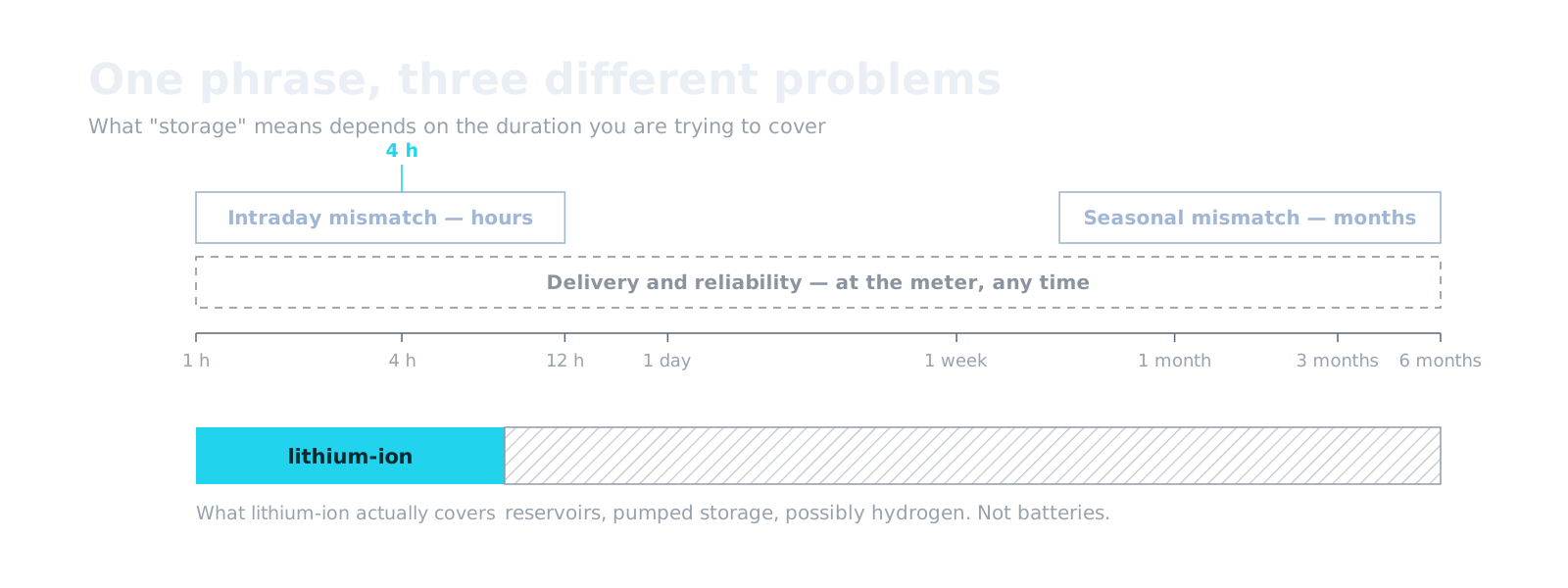
That is the system-level problem. But it is really three separate problems, and they have different timescales.
The intraday mismatch, measured in hours
Nepal’s demand peaks twice a day, roughly 06:00 to 09:00 and 17:00 to 23:00. Run-of-river hydropower, which dominates the fleet, cannot follow that. Water arrives when it arrives. Solar arrives when the sun is up, which is precisely between the two peaks.
This is the classic storage problem. Four hours of storage covers it.
The seasonal mismatch, measured in months
Dry season river flows collapse. Run-of-river plants produce a fraction of nameplate. Nepal imports. Wet season flows surge, generation exceeds what the domestic market and the export quota can absorb, and water spills past the intake.
Lithium-ion does not solve this. A four-hour battery cycled daily moves energy from 13:00 to 19:00. It does not move energy from Ashadh to Magh. Anyone who tells you batteries fix Nepal’s seasonal problem is selling something. The tools for a seasonal shift are reservoir hydropower, pumped storage, and possibly green hydrogen. Batteries are the wrong instrument at that timescale.
I want to be blunt about this because the confusion is common in Nepali energy discourse: the daily problem and the seasonal problem get merged into one sentence, and then batteries get credit or blame for something they cannot do.
Delivery and reliability, measured at the meter
This is the one that gets least attention and, in my view, matters most commercially today.
Anjal Niraula of Gham Power has been making this argument consistently, and he framed it well on The Doers Podcast: everyone talks about Nepal’s generation potential, but generation is only half the equation. His analogy is water. Building bigger reservoirs means little if the pipes are too small. Nepal is adding generation capacity fast, but without proportionate investment in transmission lines, substations and grid modernisation, much of that capacity stays trapped.
At the customer’s meter, the consequence is voltage sag, tripping, and outages, in a country that on paper has surplus power. An industrial site in Sunsari-Morang does not care about the national energy balance. It cares that the line dropped for forty minutes and the melt was ruined.
That last problem, the one at the meter, is where battery storage in Nepal actually earns money right now.
What a BESS actually is, in plain terms
If you already know this, skip ahead. If you are coming from a hydro or PV background, this is the vocabulary you need.
The water tank analogy
I use this constantly when teaching because it maps almost perfectly:
| Battery concept | Water analogy | Unit |
|---|---|---|
| Battery capacity | Size of the tank | kWh |
| Power rating | Flow rate through the pipe | kW |
| Inverter / PCS | Diameter of the pipe | kW |
| State of Charge (SOC) | How full the tank is right now | per cent |
| Depth of Discharge (DoD) | How far you drain it each cycle | per cent |
| State of Health (SOH) | Whether the tank has developed rust | per cent |
| C-rate | How fast you empty the tank | 1/hour |
| Round-trip efficiency (RTE) | Water lost in filling and emptying | per cent |
| BMS | The doctor watching the tank | |
| EMS | The brain deciding when to fill and drain |
The single most common error I see in Nepali proposals is confusing kW and kWh. A 100 kW / 400 kWh system and a 400 kW / 100 kWh system cost similar money and do completely different jobs. The first shaves a peak for four hours. The second handles a fast transient for fifteen minutes. Get this wrong and the project fails no matter how good the hardware is.
From cell to container
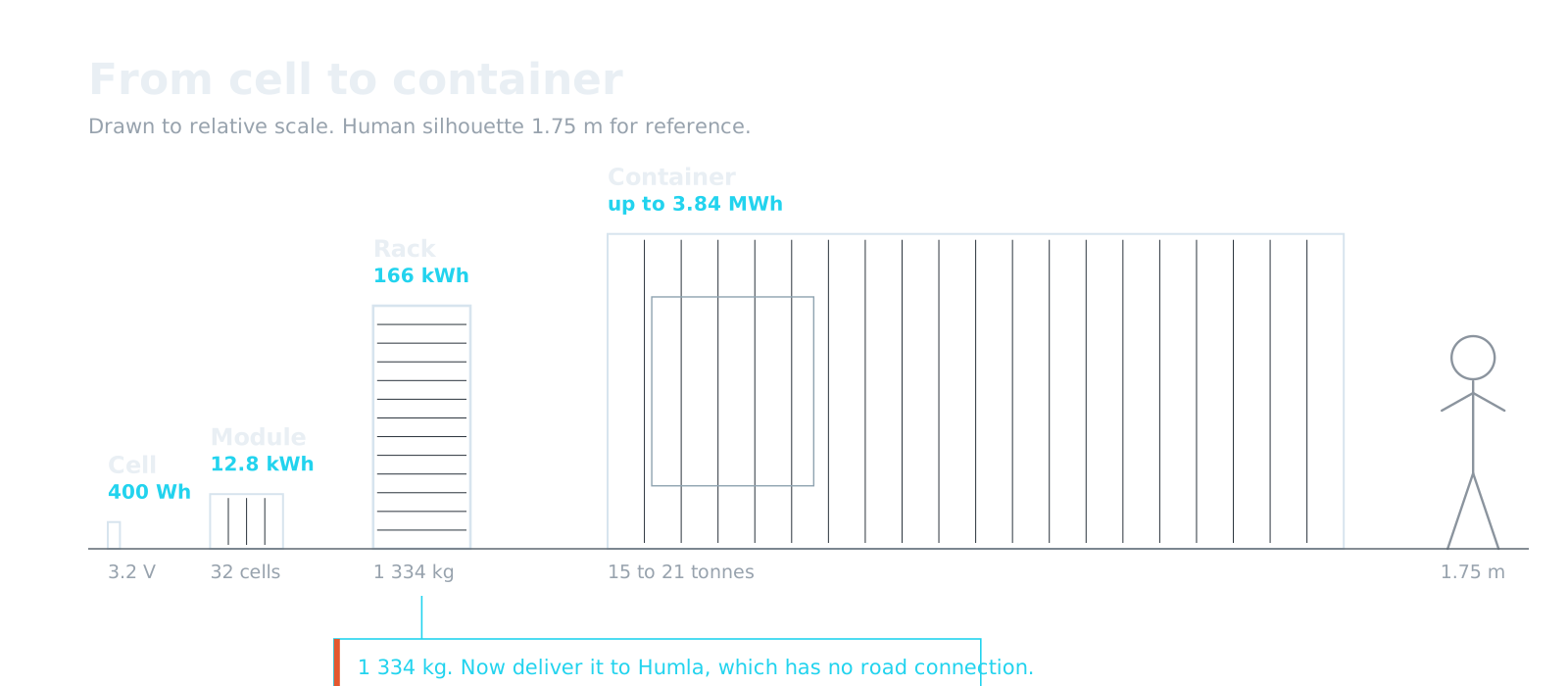
Real numbers from a published LFP product family, the Narada NESP series. I use it as a reference set because the datasheet is public and because it is the range most often quoted in Nepali proposals, not as a recommendation:
| Level | Specification |
|---|---|
| Cell | FE125A, LFP prismatic, 3.2 V nominal, 125 Ah, 400 Wh |
| Module | 51.2NESP250, 16S2P, 51.2 V, 12.8 kWh, 32 cells |
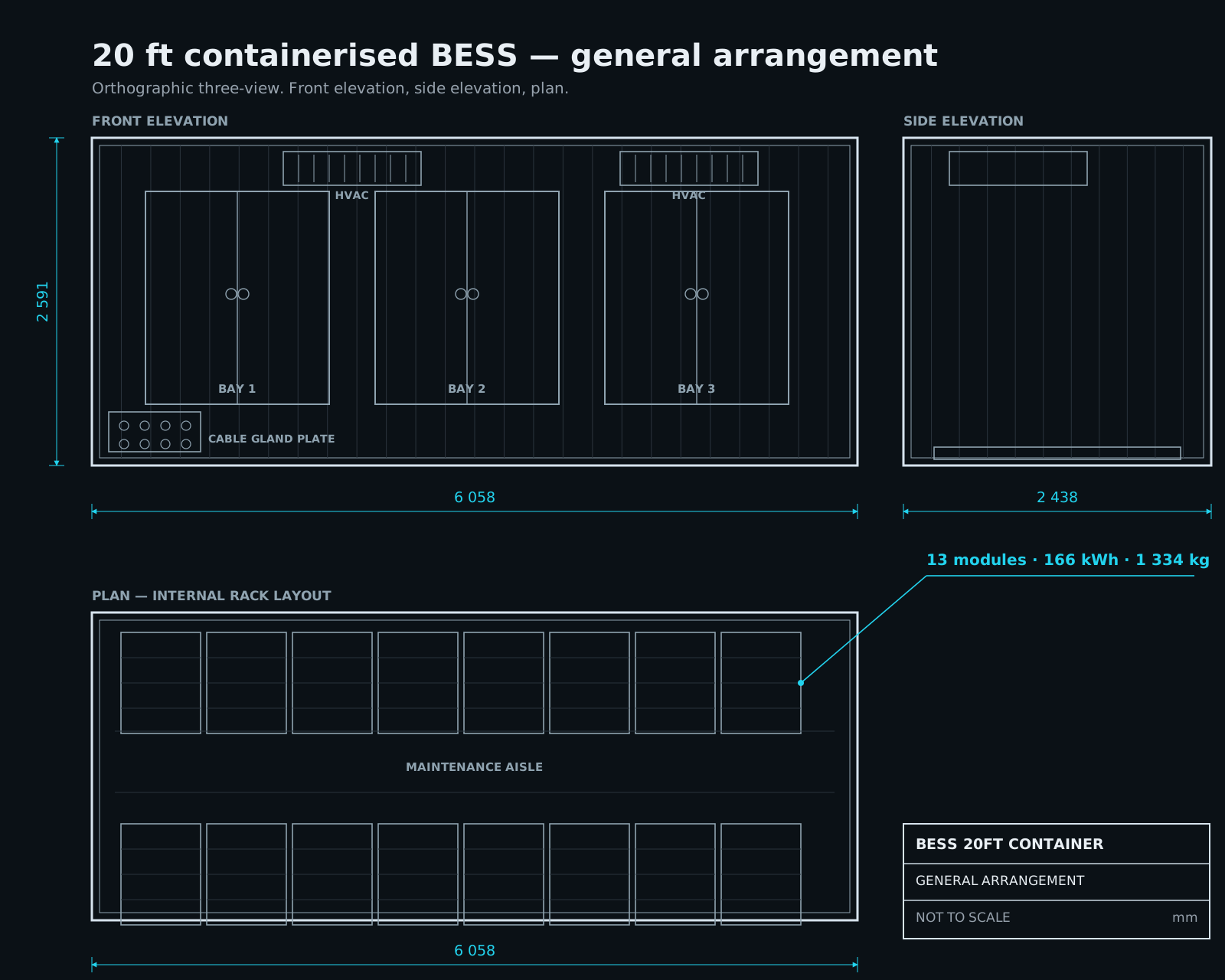
| Rack (Type 2) | 13 modules, 665.6 V, 166 kWh, 1,334 kg |
| Container (40 ft) | up to 3.84 MWh |
| RTE (DC side) | greater than 95 per cent |
| RTE (AC, at point of interconnection) | greater than 84 per cent |
| Recommended SOC window | 5 to 95 per cent |
| Cycle life | 2,000 at 90 per cent SOH, 6,000 at 80 per cent, 10,000 at 70 per cent |
| Rated altitude | 2,000 m |
Two numbers there deserve highlighting.
The 84 per cent AC round-trip efficiency. Datasheets love to quote the DC figure of 95 per cent plus. That is the battery. What you actually get at the meter, after the PCS converts twice, after the transformer, after the HVAC and BMS and fire panel draw their auxiliary load, is around 84 per cent. Every economic model must use the AC number. Using the DC number inflates arbitrage revenue by roughly 13 per cent, which is enough to turn a bad project into a spreadsheet-good project.
The 2,000 m altitude rating. Hold that thought.
The four boxes that matter
The BMS is the doctor: cell voltage, current, temperature, balancing, and tripping the contactor before something bad happens. The PCS is the pipe: bidirectional DC to AC, and it sets the power rating. Its DC input voltage window determines which battery racks you can even connect. This is the check that most often eliminates the cheapest bid, because a rack whose voltage band does not overlap the PCS input range for a standard 400 V AC output cannot be connected at all. Cheaper product, unbuildable system. The EMS is the brain, deciding when to charge and discharge against tariff, load, PV and SOC; a perfect battery with a stupid EMS earns nothing. HVAC and fire safety are unglamorous, non-optional, and the largest parasitic load in the system.
Finally, position relative to the meter defines the whole commercial model. Front-of-the-Meter is a grid asset selling services to the system. Behind-the-Meter sits on the customer side, selling avoided cost to one site. Nepal’s regulatory framework is far more accommodating to BTM than FTM, mostly by accident.
Why a grid battery is not a car battery
Tesla’s Megapack and BYD’s utility-scale cubes both run lithium iron phosphate, not the nickel-rich chemistries in long-range EVs. This is not ideology. A stationary battery sits on a concrete pad and does not care about weight, so it trades energy density, where LFP loses, for cycle life, thermal stability and cost, where LFP wins decisively.
The market caught up with that logic in a striking way. BloombergNEF’s 2025 survey found stationary storage pack prices fell to about USD 70 per kWh, a 45 per cent single-year drop and the steepest decline of any battery segment. For the first time, the pack in a grid battery is cheaper per kWh than the pack in an electric car, at around USD 99 per kWh for BEVs.
What storage can sell in Nepal, and what you can get paid for
There are roughly nine services a battery can provide to a power system. Here is the honest Nepal scorecard:
| Service | Technically possible | Paid for in Nepal today |
|---|---|---|
| Energy arbitrage (ToD) | Yes | Yes, via avoided tariff (BTM) |
| Demand charge reduction | Yes | Yes, via avoided kVA charge (BTM) |
| Diesel generator displacement | Yes | Yes, via avoided fuel (BTM) |
| Solar self-consumption | Yes | Yes, partially |
| Backup power / islanding | Yes | Yes, via avoided outage cost |
| Frequency regulation | Yes | No |
| Spinning / operating reserve | Yes | No |
| Voltage support | Yes | No |
| Black start | Yes | No |
Every “no” in that right-hand column is a policy choice, not a physics constraint. Nepal’s grid code requires generators to provide ancillary services but does not compensate them separately, and under the framework as assessed, pumped storage hydro is the only storage technology recognised as eligible to provide most of these services in the first place.
This has a direct consequence for anyone modelling a utility-scale battery in Nepal: half the revenue stack that makes grid batteries bankable in India, Europe or the US simply does not exist here yet. A 100 MW battery in Gujarat earns capacity payments and ancillary revenue. The same battery in Nepal, today, earns whatever NEA’s internal cost-of-service accounting assigns it.
That is why the honest near-term answer for private capital in Nepal is behind the meter.
Does the arithmetic work? Let us actually do it
This is the section most articles skip. I am going to run the numbers on a realistic industrial site and show where it works and where it does not.
The tariff reality
NEA’s Time-of-Day tariff for FY 2081/82, industrial consumers:
| Period | Demand charge | Peak (17:00-23:00) | Normal | Off-peak (23:00-05:00) |
|---|---|---|---|---|
| Baisakh to Mangsir | NPR 250/kVA/month | NPR 10.50 | NPR 8.55 (05:00-17:00) | NPR 5.40 |
| Paush to Chaitra | NPR 250/kVA/month | NPR 10.50 | NPR 8.55 (23:00-05:00) | none published |
Read the second row carefully. During Paush to Chaitra, the dry season, the published ToD schedule for industrial consumers has no off-peak rate at all. The spread between peak and the cheapest available rate collapses from NPR 5.10 to NPR 1.95 per kWh.
This is the single most important fact for BESS economics in Nepal, and I have not seen it discussed anywhere. In the four months when the country most needs storage, the tariff signal that would pay for storage disappears. The tariff is designed to discourage consumption in the dry season, not to encourage anyone to build the asset that would relieve it.
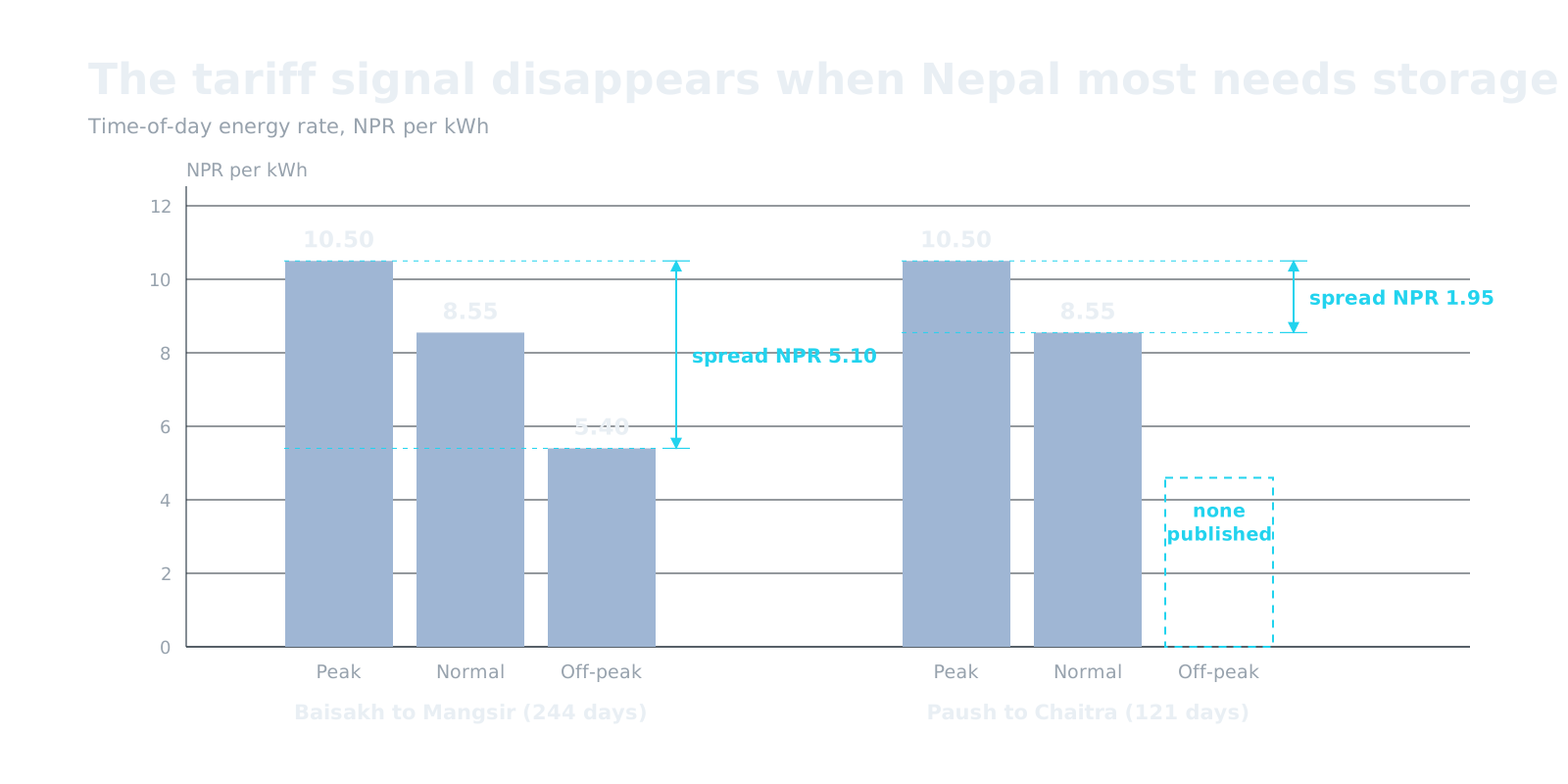
The structural claim here holds up independently of the exact figures: reporting on NEA’s time-of-day framework consistently describes the same peak window (17:00 to 23:00) and the same asymmetry, a defined off-peak block in the flush season with no equivalent published for the dry season, only a flat “other” rate. That gap is the argument, and it is not an artefact of one table. The specific rupee figures above are the schedule industrial consumers are billed against for FY 2081/82; NEA revises this periodically, so open your own bill or the current ERC tariff order against it before you commit a proposal to a client.
Worked example: an industrial site on ToD metering
Site: industrial consumer, 11 kV supply, ToD metering, existing diesel genset for outages.
System: 100 kW / 250 kWh nameplate LFP, 80 per cent usable DoD, so 200 kWh delivered per cycle. AC round-trip efficiency 84 per cent.
Installed cost assumption: USD 300 per kWh nameplate, turnkey, delivered and commissioned in Nepal.
A note on that assumption, because it is the number people get most wrong. BloombergNEF’s 2025 survey puts the global average turnkey BESS price at USD 117 per kWh, and USD 110 for four-hour systems. That figure is for utility-scale projects buying hundreds of MWh at a time, mostly in China. A sub-MWh commercial system landed in Kathmandu carries freight, customs, a small-order premium, local EPC, civil works and a thin service market. Two to three times the global benchmark is realistic. I use USD 300 per kWh and flag it as the assumption most likely to be wrong in either direction.
At roughly NPR 153 per USD, Nepal Rastra Bank’s selling rate in August 2026: 250 kWh × USD 300 × 153 = NPR 1.15 crore installed.
Revenue stream one: ToD arbitrage
Baisakh to Mangsir, roughly 244 days:
- Charge off-peak at NPR 5.40 per kWh
- Delivered cost per kWh at 84 per cent RTE = 5.40 ÷ 0.84 = NPR 6.43
- Discharge at peak, avoiding NPR 10.50
- Margin = NPR 4.07 per kWh
- 200 kWh × 244 days × 4.07 = NPR 1.99 lakh
Paush to Chaitra, roughly 121 days:
- Best available charging rate is Normal at NPR 8.55
- Delivered cost = 8.55 ÷ 0.84 = NPR 10.18
- Discharge avoiding NPR 10.50
- Margin = NPR 0.32 per kWh
- 200 kWh × 121 days × 0.32 = NPR 0.08 lakh
Arbitrage total: NPR 2.07 lakh per year. For four months of the year, the battery is economically idle.
Revenue stream two: demand charge reduction
Demand charge is NPR 250 per kVA per month, billed on the maximum recorded demand.
- Optimistic case, 100 kVA shaved reliably every month: 100 × 250 × 12 = NPR 3.00 lakh
- Realistic case, 60 kVA shaved reliably: 60 × 250 × 12 = NPR 1.80 lakh
Why the discount? The demand charge is set by a single interval in the whole month. A 100 kW / 200 kWh battery can hold 100 kW for two hours. The peak window is six hours. If the plant’s maximum demand lands outside the two hours you covered, or lands twice in one evening, you pay the full charge anyway. Sizing for reliable demand shaving usually means more energy than the arbitrage case wants.
The verdict on tariff arbitrage alone
| Case | Annual saving | Simple payback on NPR 1.15 crore |
|---|---|---|
| Optimistic (arbitrage + 100 kVA shaved) | NPR 5.07 lakh | 23 years |
| Realistic (arbitrage + 60 kVA shaved) | NPR 3.87 lakh | 30 years |
An LFP battery cycled once daily reaches 80 per cent SOH after roughly 6,000 cycles, about 16 years. Warranties typically run 10 to 15 years.
The payback exceeds the asset life. On NEA tariffs alone, a behind-the-meter battery in Nepal does not pay for itself. I want that stated plainly, because proposals circulating in Kathmandu claim six or seven year paybacks on demand-charge savings. Ask them for the arithmetic.
Revenue stream three: diesel displacement, and everything changes
Now add the reason most Nepali industrial sites already own a generator.
Diesel cost per kWh. Nepal Oil Corporation’s posted Kathmandu-region high-speed diesel price was NPR 200 per litre as of August 2026, revised roughly fortnightly. A reasonably loaded genset delivers about 3.6 kWh per litre, roughly 0.28 litres per kWh, giving NPR 55.6 per kWh in fuel. Add lubricants, filters, servicing and overhaul reserve at around NPR 5 per kWh.
Diesel generation costs roughly NPR 60 per kWh.
Compare that with NPR 10.50 for grid peak power, and NPR 10.18 for battery energy charged at the dry-season Normal rate. Every kWh moved from the genset to the battery saves about NPR 50.
Assume this site loses grid supply often enough to run 200 kWh through the genset on 150 days a year, which is not aggressive given the load shedding that returned in January 2026 and NEA’s own 300 to 400 MW interruption line:
- 200 kWh × 150 days × NPR 49.82 = NPR 14.95 lakh per year
| Full stack | Annual saving | Payback |
|---|---|---|
| Arbitrage + demand charge + diesel displacement | NPR 18.82 lakh | 6.1 years |
That is the whole story of battery storage economics in Nepal in one table. The battery does not pay for itself as a tariff-arbitrage machine. It pays for itself as a diesel-replacement machine. Take away the generator and the project is uninvestable. Leave the generator in and it clears a six-year payback comfortably.
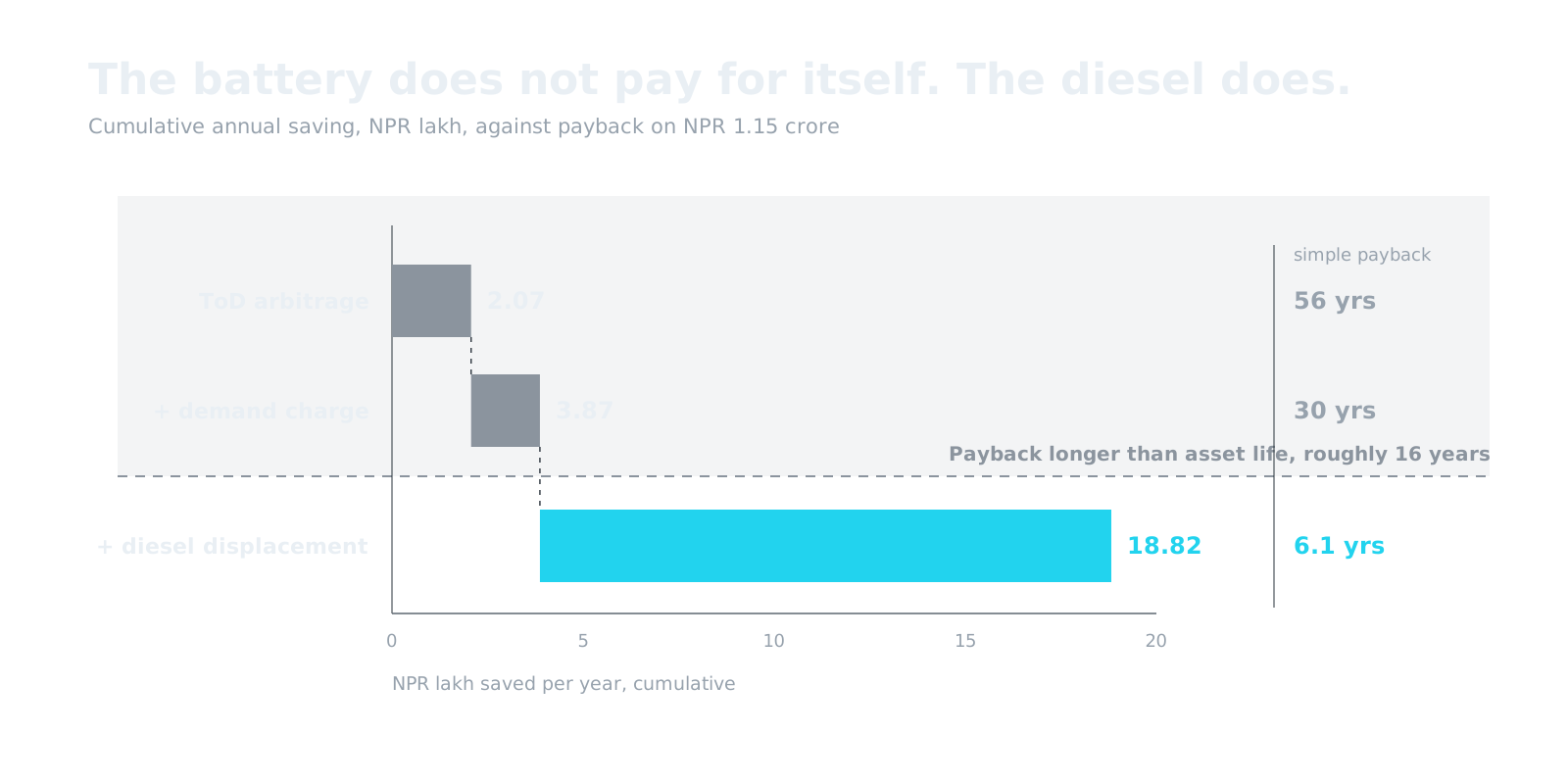
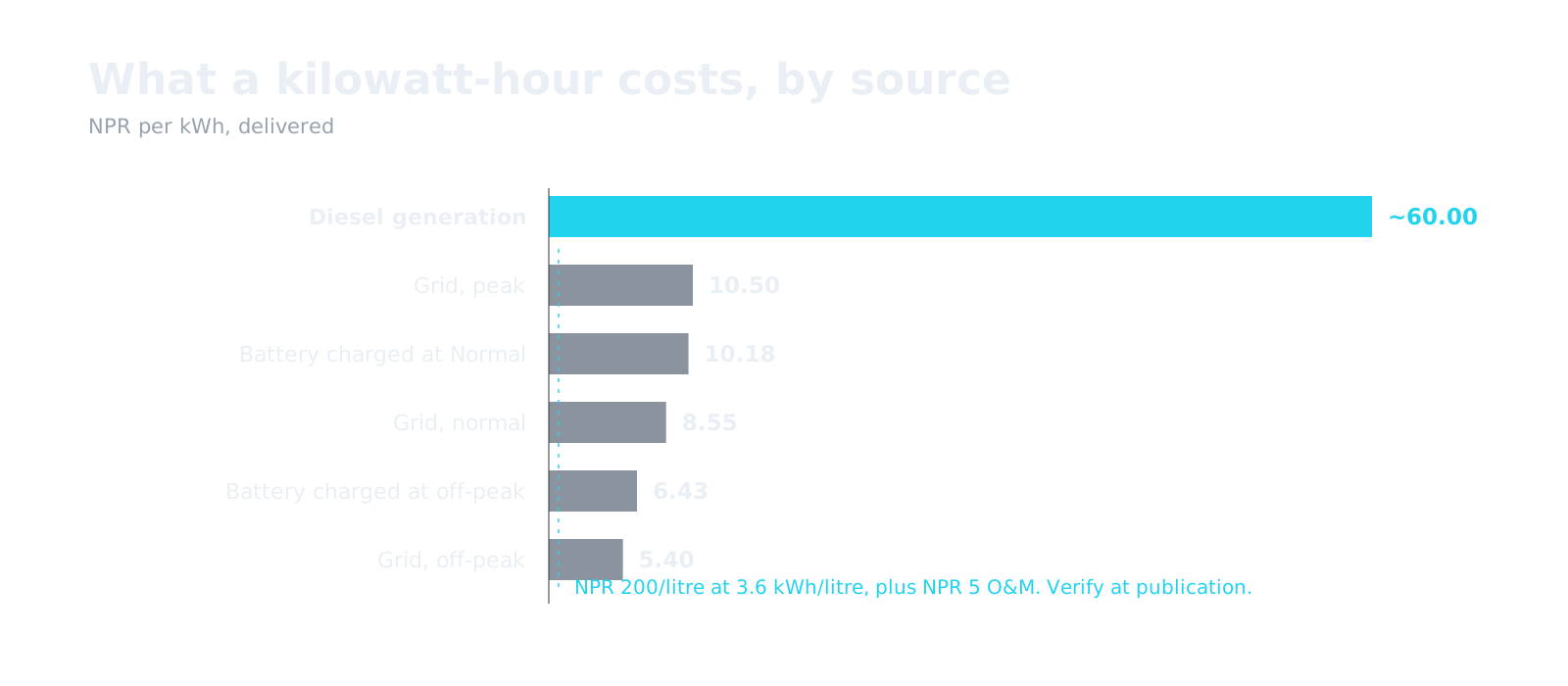
Both the diesel price and the exchange rate above are dated to August 2026 deliberately, because both move — diesel on a roughly fortnightly cycle, the rupee daily — and a payback this sensitive to two inputs should always be re-run against the current numbers before it goes in front of a client, not taken from this page.
What adding solar does
Stack a PV array in front of the battery and two things change. The charging cost drops toward zero at the margin, which lifts the arbitrage margin from NPR 4.07 to something closer to NPR 10 per kWh in the hours PV is producing. More importantly, you stop depending on grid availability to recharge, which is what makes the diesel displacement reliable rather than best-effort. Solar plus storage is a genuinely different product from storage alone, and in Nepal it is the better product.
And if you have no diesel exposure?
Then be honest with yourself. A commercial building on an 11 kV ToD tariff with reliable supply and no generator is looking at a 23 to 30 year payback. Buy the solar. Skip the battery for now. Revisit in three years when installed costs in Nepal follow the global curve down.
What is actually being built in Nepal
Enough theory. Here is the real project pipeline as of August 2026.
NEA’s Karnali solar-plus-storage projects
Nepal’s first significant grid-connected BESS deployment, funded through ADB’s SASEC Power System Expansion Project. From NEA’s FY 2081/82 annual report:
| Site | Solar (AC) | BESS as printed |
|---|---|---|
| Mugu | 360 kW | “2200 MWh” |
| Dolpa | 620 kW | “2000 MWh” |
| Jumla | 950 kW | “3800 MWh” |
| Humla | 995 kW | “3000 MWh” |
Those BESS figures are almost certainly kWh, not MWh. A 360 kW plant paired with 2,200 MWh of storage would have 6,100 hours of duration. Read as kWh, Mugu is 6.1 hours, Jumla 4.0 hours, Dolpa 3.2 hours, Humla 3.0 hours, all entirely normal for an off-grid solar hybrid. The four sites together are roughly 2.9 MW of solar and about 11 MWh of storage. I raise this not to score a point but because engineers in Nepal are citing these numbers in proposals, and a factor of a thousand matters.
Progress as of April 2026: topographical surveys, geotechnical investigation and grid connectivity assessment complete at all four sites; civil and electrical design finalised; construction underway at Jumla, where the roughly 1 MW plant near Karnali Technical School was reported around 50 per cent complete, expected to serve about 9,000 consumers, with an NPR 2 billion figure attached in reporting, though whether that covers Jumla alone or the four-district programme is not clear from the coverage.
These sites are the right use of batteries. They are remote, diesel-dependent or under-served, and there is no grid alternative. Payback is the wrong question; service delivery is the question.
GRIPS2: Nepal’s largest battery microgrid
Grid Resilience through Intelligent Photovoltaic Storage, Phase 2. Led by Practical Action with Gham Power and UK-based Swanbarton, funded through UNIDO’s Accelerate-to-Demonstrate Facility with UK Government money, one of five projects selected globally.
- 2 MW / 4 MWh lithium iron phosphate battery
- 924 kWp solar array
- Site: Laxmi Steel Factory, Sunwal
- Replaces a 4.2 MVA heavy fuel oil generator and provides generator-free backup for critical systems
- Swanbarton’s AI-driven Microgrid Management System handles dispatch
- Targets: 2,800 tonnes CO2 and 1,000 kilolitres of diesel avoided over 25 years, over USD 1.3 million saved
The framing matters. The industrial sector accounts for roughly 40 per cent of Nepal’s carbon emissions, and it does so in a country whose electricity is overwhelmingly renewable, because distribution failures push factories onto diesel. GRIPS2 attacks that specific gap. It is the clearest proof-of-concept for the economics laid out above.
Kohalpur and Banganga solar-plus-storage
Under Investment Board Nepal, with Risen Energy’s Singapore joint venture: 250 MWp of grid-connected solar with 40 MW of battery storage, split as 125 MW plus 20 MW at Kohalpur in Banke and the same at Banganga in Kapilvastu. Estimated at USD 189.5 million, with IBN approving NPR 21.10 billion in foreign investment. The project has been in study and approval stages for several years. Worth tracking, not yet worth citing as installed capacity.
The FY 2026/27 budget commitment
The federal budget presented in late May 2026 committed to a battery energy storage system in Kathmandu Valley to address peak-hour shortages, alongside 1,040 MW of new generation, 670 MW hydro and 370 MW solar, and a 2.5 MW green hydrogen pilot at Hetauda. NPR 85.54 billion was allocated for generation, transmission and distribution infrastructure.
The reported size is inconsistent. Most outlets reported 100 MW. At least one considered opinion piece reported 100 MWh. These are wildly different commitments:
| Interpretation | Energy | Rough cost at global turnkey prices |
|---|---|---|
| 100 MW, 4-hour | 400 MWh | USD 44 million, about NPR 669 crore |
| 100 MWh, for example 25 MW / 4-hour | 100 MWh | USD 11 million, about NPR 167 crore |
At the 400 MWh reading, the project would absorb roughly 8 per cent of the entire energy infrastructure budget line. Anyone writing about this should say which they mean, and cite the budget document rather than the coverage. I have not been able to confirm which is correct from primary sources.
The flow battery pilot nobody is talking about
Under the Faraday Institution’s Ayrton Challenge on Energy Storage, funded by the UK government: SL2FBat, a soluble lead flow battery developed at the University of Southampton with spin-out SOLead Energy, integrated by Swanbarton and hosted by Gham Power at its Kathmandu premises. A containerised 10 kW / 20 kWh prototype, to be operated for at least three months under real conditions.
Twenty kilowatt-hours is a rounding error in capacity terms and one of the more strategically interesting things happening in Nepali energy. Long-duration storage is what emerging economies like Nepal need to maximise seasonal hydropower surplus and replace costly diesel backup. Flow batteries decouple power from energy, tolerate deep cycling, do not have lithium’s thermal runaway profile, and can in principle be manufactured incrementally with local content. If any storage chemistry has a plausible domestic manufacturing story for Nepal, it is not lithium.
The tariff that changed the maths
Until recently there was no storage-specific PPA rate in Nepal, and the solar competitive ceiling of NPR 5.94 per kWh made adding a battery financially impossible. The fiscal budget then matched solar-plus-BESS to the reservoir hydropower rate: NPR 12.40 per kWh in the dry season and NPR 7.10 in the wet season.
That is a serious change. It is the difference between a battery being a cost centre bolted onto a solar plant and a battery being the reason the plant earns a dry-season premium. Set against it: in April 2025 NEA awarded 960 MW of solar at under 3.5 US cents per kWh, roughly 30 per cent below the hydropower tariff, with the tender three times oversubscribed. The market signal is that solar is cheap and dispatchability is what commands a premium.
The real barrier is not technology, it is the rulebook
In 2021, NREL published an Energy Storage Readiness Assessment for Nepal for the US State Department, scoring twenty criteria across system characteristics, policy and regulation. It remains the most rigorous public assessment of Nepal’s storage framework, and its central finding has aged well: the technical characteristics of Nepal’s power system are favourable for energy storage, while the policy and regulatory frameworks are largely unsupportive, mostly because storage is absent from current frameworks rather than because storage rules are badly designed.
That distinction matters enormously. Nepal has not written bad storage rules. Nepal has not written storage rules.
The criteria NREL flagged as outright barriers requiring revision:
| Criterion | Finding |
|---|---|
| Storage in energy policy and master plan | No clear vision; plans focus on pumped storage hydro |
| Utilities and private developers allowed to invest | Non-hydro storage limited to hybrid projects |
| Operating requirements for fast-responding assets | Only PSH eligible to provide most services |
| Storage able to compete to provide multiple services | Opportunities limited to PSH or hybrid projects |
| Storage able to receive revenue for multiple services | Compensation beyond energy not available |
The mechanics of the first barrier are worth spelling out. Under the Electricity Act 2049, a grid asset must qualify as generation, transmission or distribution to be licensed. The Department of Electricity Development’s licence categories are hydro, thermal, solar, wind, biomass, co-generation and transmission. A standalone battery is none of these. It does not generate; it moves energy in time. So there is no clean legal route for an independent developer to own and operate a grid-connected battery in Nepal.
The workaround everyone uses is to attach the battery to a solar licence. That works, and it explains why every announced project above is solar-plus-storage rather than standalone. It also means Nepal cannot procure the thing it most needs at system level: a battery sited where the grid is weakest, which is often nowhere near good solar resource.
On the compensation side, NREL found that generators are required to provide ancillary services but are not paid separately for them; the cost is folded into the regulated tariff or the PPA. Their modelling found that 500 MW of four-hour storage could supply 69 per cent of Nepal’s projected total reserve requirement, and 100 MW could supply 44 per cent. None of that value can currently be monetised by a private party.
They also modelled the curtailment question. With no storage, 0.6 per cent of Nepal’s hydropower generation is curtailed for lack of flexibility in their 2030 case. Adding 500 MW of four-hour storage cuts that to 0.13 per cent and increases exports to India by 728 GWh. Notably, they tested 1,000, 2,000 and 5,000 MW and found no further benefit, which is a useful discipline against unbounded ambition.
An illustration, clearly labelled as an illustration and not a business case: 728 GWh of additional exports at NPR 6 per kWh is roughly NPR 437 crore a year, against a 500 MW / 2,000 MWh system that would cost around USD 220 million, about NPR 3,344 crore, at 2025 global turnkey prices. That is under eight years on export revenue alone. Every input there is contestable: NREL modelled 2030 with 2021 cost assumptions, the export price is not fixed, Nepal does not publish curtailment data, and Nepali installed costs exceed global averages. But the order of magnitude is not absurd, and it suggests the question deserves a proper NEA-led techno-economic study rather than a budget line.
Two further gaps NREL flagged that have not closed: no safety standards for energy storage exist or are in development in Nepal, and no organisation or initiative is focused on promoting storage.
What would actually need to change
Five concrete things, in rough order of how much they would change:
- Create a licence category for standalone storage. Amend the Electricity Act, or at minimum define storage explicitly in the grid code so a battery can interconnect as a recognised asset class rather than as an appendage to a solar licence.
- Pay separately for ancillary services. Define the reserve requirement quantitatively, then compensate for it. Nothing brings fast-response investment forward faster than a price for fast response.
- Restore a dry-season off-peak window in the ToD tariff. The current schedule removes the arbitrage signal in the four months Nepal most needs storage. This costs the government nothing and is the fastest lever available.
- Adopt storage safety standards. UL 9540, UL 9540A test data, NFPA 855, and a mandatory hazard mitigation analysis above a defined threshold. Nepal can adopt by reference; it does not need to write these from scratch.
- Set a storage target in MW and MWh, not as a slice of the generation mix. A battery is a closed-loop system with no generation source of its own, so it cannot contribute to a generation-mix target. Nepal’s targets are structured in a way that makes batteries invisible.
The Himalayan constraints that are not in the datasheet
This is the section I most wanted to write, because these are the failure modes I keep seeing designed straight past.
Altitude, and the number everyone misses
The reference product family above is rated to 2,000 metres. Now look at where Nepal is putting batteries:
| Site | Elevation | Within a 2,000 m rating? |
|---|---|---|
| Mugu | 3,659 m | No |
| Dolpa | 3,641 m | No |
| Humla | 3,084 m | No |
| Jumla | ~2,300 m | No |
All four of NEA’s Karnali BESS sites exceed the standard altitude rating of the product family most commonly quoted in Nepali proposals.
Why altitude matters, physically: air density falls with elevation, so forced-air cooling moves less heat per unit volume of airflow. The same fan removes less heat at 3,600 m than at sea level. Simultaneously, the dielectric strength of air falls, which reduces creepage and clearance margins in switchgear and the PCS. Manufacturers handle this with derating curves, typically a percentage reduction in current rating per 100 m above the rated altitude, and sometimes with a different insulation class.
What this means in practice: at high-altitude sites you must request an altitude derating certificate from the manufacturer in writing at tender stage, for the battery, the PCS and the switchgear separately. Then size for the derated rating, not the nameplate. A design that ignores this either overheats or trips on insulation coordination, and either way you find out during commissioning in Mugu in February, which is the worst possible place and time to find out.
Temperature: two different problems
Cold. LFP cells must not be charged below 0 degrees C. Doing so causes lithium plating on the anode, which is permanent capacity loss and, in the worst case, an internal short. Karnali sites go well below freezing for months. This means the thermal management system must be able to heat, not just cool, and the BMS must lock out charging until cells reach a safe temperature. That heating draws parasitic energy, in winter, at exactly the time solar yield is lowest. Model it. It is not a rounding error.
Cold also increases internal resistance, which reduces available discharge capacity before the voltage cut-off is reached. A battery rated for 200 kWh usable at 25 degrees C delivers meaningfully less at minus 5.
Heat. In the Tarai, ambient can exceed 40 degrees C for weeks. Every 10 degrees above the ideal 15 to 25 degree band roughly doubles the rate of chemical ageing. The HVAC then runs continuously, and HVAC is the largest single auxiliary load in a BESS. This is the main reason site-measured round-trip efficiency comes in below datasheet values, typically 89 to 92 per cent for DC-coupled and lower for AC-coupled.
Logistics, which is not a footnote in Nepal
A single 13-module rack in the reference range weighs 1,334 kg. A 40-foot container BESS runs 15 to 21 tonnes.
Now imagine delivering that to Mugu, or to Humla, which has no road connection to the national road network at all. The battery is the easy part. The crane, the road-widening, the bridge load ratings, the seasonal access window before the passes close, and the fact that the same crane will be needed again in year eight for module replacement: those are the project.
For remote Nepal, this argues strongly for smaller modular units that can be carried by a small truck or manhandled, even at a cost premium per kWh, over container solutions optimised for a Chinese industrial park with a paved apron.
Grid quality
Nepali distribution feeders are long, lightly meshed, and prone to voltage excursions and frequency deviation. A PCS configured with tight voltage and frequency ride-through windows will trip constantly and the client will conclude the battery is faulty. Specify ride-through settings against actual measured site conditions, not the factory default. Take a week of power-quality logging before finalising the settings.
Lightning is a real hazard across the Tarai and the mid-hills. Surge protection on both the DC and AC sides, plus a properly designed earth termination system, is not optional. Type 1+2 SPDs on the PV DC side, Type 2 on the BESS DC side, Type 1+2 on the AC output.
Spares, skills and the O&M cliff
Nepal has, as far as I can establish, no domestic capacity to repair a PCS at board level, no lithium cell testing laboratory, and no battery recycling pathway. A failed module goes back to China or sits in a store room.
This is the argument for the training work rather than an aside to it. The technology can be imported. The capability to keep it running for fifteen years cannot.
End of life
Nobody in Nepal has answered this. What happens to 4 MWh of LFP cells in 2045? There is no domestic recycling capability, no extended producer responsibility framework, and no disposal regulation covering lithium batteries at grid scale. It is a small problem today and a guaranteed one later. The cheapest time to write that rule is before the fleet exists.
Safety, the section everyone skips
On 16 January 2025, a fire broke out at the 300 MW Phase I facility at Moss Landing in Monterey County, California, at the time one of the largest battery installations in the world. About 1,200 residents were evacuated for 24 hours. Cleanup, including demolition to the foundation, has run into 2026.
The important detail is not that it burned. It is why: Moss Landing was one of the earliest large-scale BESS installations and was designed and accepted before NFPA 855, the first fire safety standard for stationary energy storage, was published in 2020. It is a monument to a pre-standards era, not a verdict on modern batteries.
A more instructive comparison for anything Nepal will build in the next decade is the December 2025 fire at a 4 MW / 17.9 MWh facility in Warwick, New York, traced to a likely manufacturing defect. That is the size range of a real Nepali industrial project.
The relevant standards:
| Standard | What it covers |
|---|---|
| UL 9540 | Safety standard for the energy storage system and equipment as a whole |
| UL 9540A | Test method for thermal runaway fire propagation; produces the data an authority uses to set spacing |
| NFPA 855 | Installation standard: siting, spacing, separation, ventilation, detection, suppression, commissioning, decommissioning |
| IEC 62933 | International series on electrical energy storage systems |
| IEEE 1547 | Interconnection and interoperability of distributed resources |
Nepal has adopted none of these as national requirements. The Nepal Electricity Grid Code 2080 sets technical standards for grid-connected facilities but does not provide a storage-specific safety regime.
In the absence of a national standard, put it in the contract. For any BESS procurement in Nepal, I would require:
- UL 9540 certification for the complete system, not just the cells.
- UL 9540A test report at cell, module, unit and installation level, provided in full, not as a summary certificate.
- A Hazard Mitigation Analysis demonstrating that a single-cell thermal runaway will not cascade.
- LFP chemistry for anything stationary in Nepal. Higher thermal runaway onset temperature, around 270 degrees C for LFP against roughly 210 for NMC, no oxygen release from the cathode during runaway, and a far less toxic combustion product profile. There is no weight penalty that matters on a concrete pad.
- Off-gas detection, not just smoke detection. Cells vent before they burn. Detecting the vent gas buys minutes.
- A written emergency response plan handed to the local fire service, plus a pre-incident guide identifying the exact chemistry. A fire crew arriving at a burning battery without knowing whether it is LFP or NMC cannot make a correct decision about water application or downwind evacuation.
- Deluge or water-mist suppression sized for the enclosure, with explicit acceptance that lithium fires are managed by cooling adjacent cells, not extinguished.
None of this is expensive at the design stage. All of it is impossible to retrofit.
A short method for sizing one
For anyone moving from reading to doing, this is the sequence I use. It is deliberately boring.
- Get 12 months of interval data and define the job in one sentence. Not the monthly bill: the 15 or 30-minute demand profile. Then commit to one job. “Shave 80 kVA.” “Cover 4 hours of outage on the critical load.” A battery asked to do three jobs badly is worse than one doing one job well.
- Size energy, then apply DoD and degradation. Required usable kWh ÷ max DoD = nameplate. At 80 per cent DoD, 200 kWh usable means 250 kWh nameplate, plus 15 to 20 per cent so it still meets spec in year 10.
- Size power from the peak, then check the C-rate. A 0.5C product cannot deliver 250 kW from 250 kWh.
- Check the PCS DC voltage window against the rack voltage band, and derate for altitude and temperature. Do both before pricing anything. The rack’s end-of-discharge voltage must sit above the PCS minimum and its full-charge voltage below the PCS maximum.
- Model the EMS logic against the actual tariff, hour by hour, for a full year, then calculate payback on AC round-trip efficiency. Not an average day, and not the DC figure. The Paush-to-Chaitra collapse in the ToD spread only appears if you model the seasons separately.
So: does it make sense?
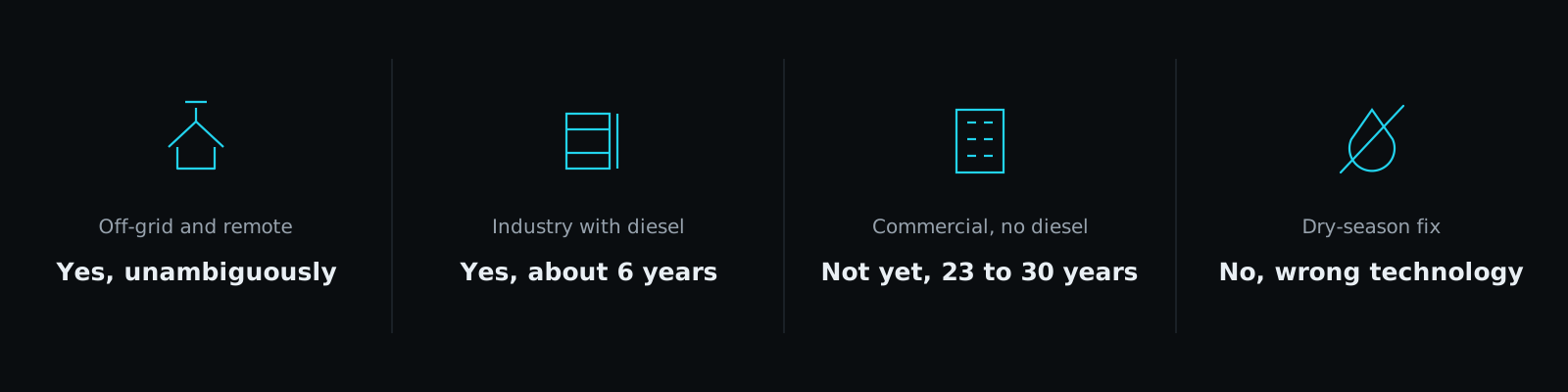
Segment by segment, my honest view.
Off-grid and remote grid-edge, meaning Karnali, mountain districts, telecom towers, health posts. Yes, unambiguously. There is no competing option. The question is not payback, it is whether the design survives altitude, cold and logistics.
Industrial and commercial sites with diesel exposure. Yes. This is the strongest commercial case in Nepal today, by a wide margin: roughly six years against roughly thirty for a site without a generator. Every Nepali factory currently burning diesel through outages is a candidate.
Commercial sites without diesel exposure, on tariff arbitrage alone. No, not yet. Buy solar instead. Revisit when installed costs in Nepal approach global benchmarks, or when NEA restores a dry-season off-peak window.
EV charging hubs. Promising, under-analysed. A fast charger is a large intermittent load on a weak connection, which is the textbook case for a buffer battery: the battery lets you install a 150 kW charger behind a 50 kVA connection. Nepal’s EV adoption is extraordinary by any international standard, with roughly two of every three cars sold in 2025 being electric. Whether the economics work depends heavily on charger utilisation, and nobody has published good Nepali utilisation data. This is the gap I would most like to see someone fill.
Utility-scale, front-of-meter. Technically justified, commercially blocked. A standalone battery cannot be licensed, ancillary services are not compensated, and the tariff framework has no storage rate. Until those three change, utility-scale storage in Nepal is something NEA does on its own balance sheet or nobody does.
As a fix for the dry season. No. Lithium-ion is a daily-cycling technology. Nepal’s seasonal problem needs reservoirs, pumped storage, cross-border trade, and possibly hydrogen.
The one-line answer to the title question: battery storage in Nepal makes sense wherever it is displacing diesel or serving a place the grid does not reach, and does not yet make sense as a pure tariff-arbitrage asset. Everything else is a policy question, and the policy is fixable.
A note on where this comes from
Some of what is above came out of a project rather than a library. Quasar Energy Consultants and Khwopa College of Engineering ran a twelve-hour Applied BESS course for third and fourth year engineering students in Bhaktapur, built around Nepal data, published datasheets, and four teaching case studies: a Rukum health post, a Kathmandu office, a Bhaktapur factory and a Dolpa mini-grid. I built and delivered much of the technical content.
The reason for mentioning it is not the training. It is what the training exposed. Nepal is committing public money to battery infrastructure in the Karnali, in the Kathmandu Valley, and through the solar-plus-storage tariff, while having almost no domestic engineering workforce that has sized a battery, read a BMS fault log, or specified a PCS voltage window. That gap will show up as commissioning delays, warranty disputes and stranded assets long before it shows up in a policy document.
The hardware can be bought. The judgement about whether the hardware is right for a site at 3,659 metres has to be developed here.
Frequently asked questions
Is battery storage cheaper than pumped hydro for Nepal?
Different jobs. Batteries win on speed of deployment, months against a decade, on siting flexibility, and on sub-second response. Pumped storage wins decisively on cost per kWh at long duration and on asset life. Nepal has identified substantial pumped storage potential and should pursue both. Do not let anyone frame it as a competition.
Why do batteries not solve Nepal’s dry-season shortage?
Because a four-hour battery moves energy across hours, not months. Storing monsoon energy for winter needs a reservoir, not a cell.
What round-trip efficiency should I use in a model?
About 84 per cent AC at the point of interconnection for a well-specified AC-coupled system, and roughly 89 to 92 per cent measured on site for DC-coupled. Not the 95 per cent-plus DC figure on the datasheet.
Which battery chemistry for Nepal?
LFP for anything stationary. Higher thermal runaway onset, no cathode oxygen release, longer cycle life, lower cost, and the weight penalty is irrelevant on a fixed installation.
Can a private company build a standalone battery and sell services to NEA?
Not cleanly, under the framework as currently assessed. Standalone storage does not fit any existing licence category. Practical routes today are behind-the-meter installations, or storage attached to a solar generation licence.
What is the biggest technical mistake in Nepali BESS proposals?
Two, equally common. Confusing kW with kWh, and ignoring altitude derating at high-elevation sites.
Sources and further reading
- Nepal Electricity Authority, A Year in Review, Fiscal Year 2024/25
- NREL, Policy and Regulatory Environment for Utility-Scale Energy Storage: Nepal, NREL/TP-5C00-80591, September 2021
- Ashish Garg (IPPAN), Turning Potential into Power: Addressing Nepal’s Energy Sector Paradox, February 2026
- BloombergNEF, Energy Storage Systems Cost Survey 2025 and Lithium-Ion Battery Price Survey 2025
- Practical Action, Gham Power and Swanbarton, GRIPS2 project documentation, and UNIDO’s Accelerate-to-Demonstrate Facility
- The Faraday Institution, Ayrton Challenge on Energy Storage, SL2FBat project
- Narada NESP Series LFP Battery Energy Storage System specification
- Anjal Niraula, The Doers Podcast, EP 210 and EP 314
- Nepal Rastra Bank, foreign exchange rates, and Nepal Oil Corporation, retail fuel prices
If you spot an error in the arithmetic or have better data, particularly on Nepali installed BESS costs or EV charger utilisation, I would like to hear about it.